Page 2 of 4

Re: The Philosophy of Obesity

Posted: Wed Feb 02, 2022 12:43 pm
by Sculptor
Veritas Aequitas wrote: Wed Feb 02, 2022 8:40 am
Sculptor wrote: Tue Feb 01, 2022 12:47 pm
Veritas Aequitas wrote: Tue Feb 01, 2022 6:59 am
You seem to be well verse and in depth with the subject of obesity.

The interesting philosophical consideration is why people like Ancel Keys are so dogmatic and ideological with their views to the extent that millions of people are now suffering within the obesity epidemic and many people had died of the related chronic diseases.


Agree. I have been researching in depth into the bio-chemistry of the above subjects. Note Fructose which is not glucose and it is not measured in a glucose-meter is much more dangerous. Fructose goes direct to the liver and excess of that cause Fatty Liver [..I was a casualty of Fatty Live but now have reversed it] and all its related problems.


I need to make a correction here, the Energy Balance Model EBM is similar to the CICO model but use Energy instead of Calories. Thus obesity is due to taking in more energy than expending energy.
I have to make an intervention here. Calories are energy. The calorie is a unit of energy. The only way we put in energy is through calories.
Despite being a blunt stick CICO is an indelibly true statement. You cannot loose weight unless you manage to make a calorie deficit.
Clearly with most simplifications it misses the nuance. one might decide to embark upon a calorie limited diet. But this always leads to a reduction of BMI as the body goes into a starvation mode. The body needs fewer calories and the only way to get your deficit is to reduce calories further - this is a downward spiral and usually ends with the dieter giving up, where upon the body makes you hungry to get back what it thinks you need.
CICO is a general rule but there are exceptions to it when dealing with obesity and weight loss.

1. The hormone that is responsible in storing fats in the cells is Insulin.

I already said that above. BUT more importantly....
It's primary an immediate function is to take sugar out of the blood to store it as glycogen in the Liver.
Fat deposition happens mostly after the glycogen stroage is full. And conversely fat will not be so readily reduced unless and until the glycogen storage is no longer capable of making enough sugar in times of scarsity.
FOr diets to be effective glycogen has to be significantly reduced or absent for neoglocogenesis occur from the break up of fat.
2. Thus if one eat high calories food that do not trigger the secretion of Insulin, they will not cause fat to be stored thus no weight gain in terms of fats storage.
You have this wrong. Even fat can trigger insulin. All eating, high or low calory triggers insulin. The trick is to avoid a massive hit of refined carbs which spike insulin and cause insulin resistence, inflamation and metabolic syndrome leading to diabetes.

Note: 5 high-calorie foods that may actually help you lose weight
https://www.insider.com/high-calorie-fo ... oss-2018-7
Fake news site. Not reeally a good science page. You would have to have alot more knowledge to make that work. FOr most people this is highly misleading, and I should imagine that food manufacturers would be very pleased with such awfully deceiving articales.

This is why in a Keto diet one can eat as much fats [very high in calories but healthy] but still will lose weights.
HOW EATING FAT MAKES YOU THIN
https://www.eatthebutter.org/fat-makes-you-thin#
No. The body is highly parrsimonious. CICO cannot be denied. This is the law of of physics.
You really need to be more discriminating with your selection of INTERWEEB BS.
EAT THE BUTTER. Says the dairy industry of the USA.

You simply cannot eat "AS MUCH AS YOU LIKE", that is the dumbest thing I have read in a long time. If I eat a Lbs of butter and a pint of olive oil the body will store it.
If you are going to post this nonsense I do not think there is any thing more to say.
I suggest you read some books, not food industry promoted web pages.
Start with something easy liek Jason Fung MD "The essential guide to fasting"
Re: The Philosophy of Obesity

Posted: Wed Feb 02, 2022 4:22 pm
by Walker
Veritas Aequitas wrote: Wed Feb 02, 2022 9:43 am You mentioned the 'chemical' factor which is evidently proven by some to be the critical root cause of obesity at present.
The mindfulness of shedding lard …

When in the throes of hunger it’s best to have a simple tack to tactfully sail past temptation. Neem Karoli Baba advised to feed everyone, however he also offered some sound advice for appetite control. So simple. He said if you’re hungry just wait a bit, and the hunger will leave. Same for thirst.

Try it and see. It’s true. Hunger brings a feeling of desperation and by doing this, by just pausing in the present moment without the urge or desire to change the present moment, the body learns that these new sensations won’t cause one to die, and are pleasurable in a different way than chewing and swallowing.

Of course, eventually it’s necessary to eat and drink, so while slowly eating each bite as if it's the last bite, frequent pauses are necessary so that the full pleasure of sensations can be felt, since they don’t all arrive at the same moment. Patience with the food is required. Since it’s the last bite, enjoy it. Savor it. It’s about the placement of attention, and of course it’s about making food the slave to need, and not the master of need.

About the chemistry of healthy food … when eating becomes a more rare event, then the body tends to naturally select the most appropriate food from what’s available, and self-education is part of that.

At first the new sensations can all-consume attention, but this is very important ... those new sensations will become integrated into the totality of life and accepted, 'specially if you don't give yourself a choice, which is why the truly obese check into a clinic.

The clinic removes choice, like a master removes a slave's options.

Re: The Philosophy of Obesity

Posted: Wed Feb 02, 2022 5:19 pm
by Walker
Veritas Aequitas wrote: Wed Feb 02, 2022 9:43 am Fundamentally it is due to lack of willpower ...

... There is no need to resort to any spiritual nor control of willpower with the CIM model.
Consulting the power of six to reveal the way things are in the philosophy of obesity, and life …

Shape-shifters pragmatically master form dynamics.

Form-shifters sculpt by imposing form.

Re: The Philosophy of Obesity

Posted: Thu Feb 03, 2022 8:18 am
by Veritas Aequitas
Sculptor wrote: Wed Feb 02, 2022 12:43 pm
Veritas Aequitas wrote: Wed Feb 02, 2022 8:40 am
Sculptor wrote: Tue Feb 01, 2022 12:47 pm
I have to make an intervention here. Calories are energy. The calorie is a unit of energy. The only way we put in energy is through calories.
Despite being a blunt stick CICO is an indelibly true statement. You cannot loose weight unless you manage to make a calorie deficit.
Clearly with most simplifications it misses the nuance. one might decide to embark upon a calorie limited diet. But this always leads to a reduction of BMI as the body goes into a starvation mode. The body needs fewer calories and the only way to get your deficit is to reduce calories further - this is a downward spiral and usually ends with the dieter giving up, where upon the body makes you hungry to get back what it thinks you need.
CICO is a general rule but there are exceptions to it when dealing with obesity and weight loss.

1. The hormone that is responsible in storing fats in the cells is Insulin.

I already said that above. BUT more importantly....
It's primary an immediate function is to take sugar out of the blood to store it as glycogen in the Liver.
Fat deposition happens mostly after the glycogen stroage is full. And conversely fat will not be so readily reduced unless and until the glycogen storage is no longer capable of making enough sugar in times of scarsity.
FOr diets to be effective glycogen has to be significantly reduced or absent for neoglocogenesis occur from the break up of fat.
2. Thus if one eat high calories food that do not trigger the secretion of Insulin, they will not cause fat to be stored thus no weight gain in terms of fats storage.
You have this wrong. Even fat can trigger insulin. All eating, high or low calory triggers insulin. The trick is to avoid a massive hit of refined carbs which spike insulin and cause insulin resistence, inflamation and metabolic syndrome leading to diabetes.
I have read many times that fats generally do not trigger insulin but only in exceptional cases [like when one has insulin resistance]. Note,
The intensely high fat intake in a high-fat dieting approach at first means you need less insulin because there are so few carbohydrates, but it can increase your insulin needs through the insulin resistance created by the presence of dietary fat.
https://diabetesstrong.com/dosing-insul ... etary-fat/
I have dug extensively into the subject but do not have a strong grasp of it at present. I will dig further to confirm the point, i.e. fats generally do not trigger insulin.
Note: 5 high-calorie foods that may actually help you lose weight
https://www.insider.com/high-calorie-fo ... oss-2018-7
Fake news site. Not reeally a good science page. You would have to have alot more knowledge to make that work. FOr most people this is highly misleading, and I should imagine that food manufacturers would be very pleased with such awfully deceiving articales.
The above is based on the latest scientific research, in contrast to Ancel Keys' ideology,
where he manipulated his conclusions to frighten the majority that all fats [even saturated fats] are dangerous in contributing to cardiovascular diseases.

The majority at present is still scared of all fats but it is only a minority who are accepting to the fact is not all fats are scary. Saturated fats are good but not trans and polyunsaturated fats which are harmful.

Note this;
Nina Teicholz is the investigative journalist who, in her book The Big Fat Surprise: Why Butter, Meat and Cheese Belong in a Healthy Diet, overturned 40 years of official dietary advice and showed that meat, cheese, and butter are nutritious and need not be avoided.

At this event, Ms. Teicholz will tell of her discovery of the systematic distortion of dietary advice by expert scientists, government and big business to the detriment of the health of Americans. She will chronicle the succession of unfortunate discoveries she made, and she will describe how the Nutrition Coalition, a non-profit, bipartisan group which she founded and directs, works to educate policy makers about the need for reform of nutrition policy so that it is evidence-based.
https://www.youtube.com/watch?v=hzQAHITIUhg&t=796s
This is why in a Keto diet one can eat as much fats [very high in calories but healthy] but still will lose weights.
HOW EATING FAT MAKES YOU THIN
https://www.eatthebutter.org/fat-makes-you-thin#
No. The body is highly parrsimonious. CICO cannot be denied. This is the law of of physics.
You really need to be more discriminating with your selection of INTERWEEB BS.
EAT THE BUTTER. Says the dairy industry of the USA.

You simply cannot eat "AS MUCH AS YOU LIKE", that is the dumbest thing I have read in a long time. If I eat a Lbs of butter and a pint of olive oil the body will store it.
If you are going to post this nonsense I do not think there is any thing more to say.
I suggest you read some books, not food industry promoted web pages.
Start with something easy liek Jason Fung MD "The essential guide to fasting"
The references I quoted are done on a quickie search but it is based on researched claims that good fats can make you thin is based on the latest scientific findings which is not accepted by the majority nutritionists and doctors involved in obesity.

The point is if you take in a pound of butter and a pint of olive oil, and if no insulin is triggered nor insulin resistance, the body will not store it.
This point is not a straightforward point but there are many perspectives to it.
Since I am not 99% certain on this I will do more research on the scientific sources to reinforce my point.

I have been reading a lot of the related literatures recently, e.g. Gary Taubes, Benjamin Bikman, Mathew Walker on Sleep, and had listened to tons of Youtube videos on the subject.
Right now I am in the middle of reading Jason Fung's -The Diabetic Code.

My wife has his book on Intermittent Fasting [IF] which I had not read. I sourced my IF info from other sources.

Re: The Philosophy of Obesity

Posted: Thu Feb 03, 2022 8:28 am
by Veritas Aequitas
@sculptor,

Here are some note from Dr. Jason Fung's Diabetic Code on the subject of dietary fats which at present is seen as if all fats are evil monsters.
Dietary fats and proteins, since they raise blood Glucose very little, have minimal Glycemic Loads.
Contrary to the low-fat diet recommended by all the medical associations around the world, Dr. Willett’s healthy diet was high in dietary fat and Protein.
His diet was about reducing Sugar and refined Carbohydrates, not reducing dietary fat.

In 1990, the widespread belief was that dietary fat was evil, that dietary fat was a mass murderer, that dietary fat was vile.
The term healthy fats did not exist.
It was an oxymoron, like a jumbo shrimp.
Fatladen avocados? A heart attack in a fruit.
Fat-laden nuts? A heart attack in a snack.
Olive oil? Liquid heart attacks.
Most people fervently believed fats were going to clog our arteries, but it was only an illusion.

Dr. Zoë Harcombe, a Cambridge University–trained Obesity researcher, reviewed all the data that had been available in the early 1980s, when low-fat guidelines were introduced in the U.S. and U.K.
No proof had ever existed that natural dietary fats worsened cardiovascular disease.
The evidence for the low-fat guidelines was simply a great work of fiction.6
The science was far from settled at the time the government decided to weigh in and make the final decision to vilify dietary fat.
Yet this belief had become so entrenched both in the medical establishment and among the general public that it had become heretical to suggest refined grains and Sugars were the problem rather than dietary fat.

In the midst of our frenzied low-fat obsession, Dr. Willett’s assertion was considered high treason.
But the truth could not be concealed forever.

Chapter 4: DIABESITY: THE CALORIE DECEPTION
GLYCEMIC INDEX: DIET AND DIABETES
Various relevant points from the book,
Dietary fats only minimally raise both blood Glucose and Insulin levels.

Since Liver processing is not required, Insulin signaling is not necessary and Insulin levels remain relatively unchanged by pure dietary fats.

Eating dietary Carbohydrates, not dietary saturated fat, increases saturated fat levels in the blood.
Saturated fats in the blood [via de novo lipogenesis (DNL) ], not [via] the diet, are highly associated with heart disease.
As I had read elsewhere and confirmed by Jason Fung in the above points, dietary fats are not dangerous and do not directly cause fats storage.
I understand this is a very complex subject which i had not fully grasped yet, but I will gather some more points from Jason Fung's book and elsewhere to confirm the truth of the claim that eating dietary fats can make one thin in a specific condition.

Re: The Philosophy of Obesity

Posted: Thu Feb 03, 2022 8:56 am
by Veritas Aequitas
Walker wrote: Wed Feb 02, 2022 4:22 pm
Veritas Aequitas wrote: Wed Feb 02, 2022 9:43 am You mentioned the 'chemical' factor which is evidently proven by some to be the critical root cause of obesity at present.
The mindfulness of shedding lard …

When in the throes of hunger it’s best to have a simple tack to tactfully sail past temptation. Neem Karoli Baba advised to feed everyone, however he also offered some sound advice for appetite control. So simple. He said if you’re hungry just wait a bit, and the hunger will leave. Same for thirst.

Try it and see. It’s true. Hunger brings a feeling of desperation and by doing this, by just pausing in the present moment without the urge or desire to change the present moment, the body learns that these new sensations won’t cause one to die, and are pleasurable in a different way than chewing and swallowing.

Of course, eventually it’s necessary to eat and drink, so while slowly eating each bite as if it's the last bite, frequent pauses are necessary so that the full pleasure of sensations can be felt, since they don’t all arrive at the same moment. Patience with the food is required. Since it’s the last bite, enjoy it. Savor it. It’s about the placement of attention, and of course it’s about making food the slave to need, and not the master of need.
True, mindfulness does work but it is only by a minority.

For many even when they tried 'mindfulness' exercises their addiction to carbohydrate is so strong that it overcome whatever mindfulness power they have.

Note the number of addicts who has relapse and reverted to the old addictions.

This is why the only recourse for many is via the physical means i.e. bariatric surgery to reduce the size of the stomach. This is not fool proof and the stomach eventually can expand larger to accommodate the wrong food thus contributing to obesity again.

It is not about how much we eat but rather what type of food and in what ratio of them that we eat that cause obesity.
About the chemistry of healthy food … when eating becomes a more rare event, then the body tends to naturally select the most appropriate food from what’s available, and self-education is part of that.

At first the new sensations can all-consume attention, but this is very important ... those new sensations will become integrated into the totality of life and accepted, 'specially if you don't give yourself a choice, which is why the truly obese check into a clinic.

The clinic removes choice, like a master removes a slave's options.
Point here is, it is the chemistry reaction in the body to various food intake that cause obesity within a complex set of processes.
Scientifically it is now confirmed [not accepted by all yet] it is the irregular excessive insulin secretion to excessive carbohydrates that is the root cause of obesity.
When we manage this root cause the obesity is prevented and managed.

Re: The Philosophy of Obesity

Posted: Thu Feb 03, 2022 1:57 pm
by Sculptor
Veritas Aequitas wrote: Thu Feb 03, 2022 8:18 am
Sculptor wrote: Wed Feb 02, 2022 12:43 pm
Veritas Aequitas wrote: Wed Feb 02, 2022 8:40 am
CICO is a general rule but there are exceptions to it when dealing with obesity and weight loss.

1. The hormone that is responsible in storing fats in the cells is Insulin.

I already said that above. BUT more importantly....
It's primary an immediate function is to take sugar out of the blood to store it as glycogen in the Liver.
Fat deposition happens mostly after the glycogen stroage is full. And conversely fat will not be so readily reduced unless and until the glycogen storage is no longer capable of making enough sugar in times of scarsity.
FOr diets to be effective glycogen has to be significantly reduced or absent for neoglocogenesis occur from the break up of fat.
2. Thus if one eat high calories food that do not trigger the secretion of Insulin, they will not cause fat to be stored thus no weight gain in terms of fats storage.
You have this wrong. Even fat can trigger insulin. All eating, high or low calory triggers insulin. The trick is to avoid a massive hit of refined carbs which spike insulin and cause insulin resistence, inflamation and metabolic syndrome leading to diabetes.
I have read many times that fats generally do not trigger insulin but only in exceptional cases [like when one has insulin resistance]. Note,
The intensely high fat intake in a high-fat dieting approach at first means you need less insulin because there are so few carbohydrates, but it can increase your insulin needs through the insulin resistance created by the presence of dietary fat.
https://diabetesstrong.com/dosing-insul ... etary-fat/
I have dug extensively into the subject but do not have a strong grasp of it at present. I will dig further to confirm the point, i.e. fats generally do not trigger insulin.
Keep reading
Note: 5 high-calorie foods that may actually help you lose weight
https://www.insider.com/high-calorie-fo ... oss-2018-7
Fake news site. Not really a good science page. You would have to have alot more knowledge to make that work. FOr most people this is highly misleading, and I should imagine that food manufacturers would be very pleased with such awfully deceiving articales.
The above is based on the latest scientific research, in contrast to Ancel Keys' ideology,
where he manipulated his conclusions to frighten the majority that all fats [even saturated fats] are dangerous in contributing to cardiovascular diseases.

The majority at present is still scared of all fats but it is only a minority who are accepting to the fact is not all fats are scary. Saturated fats are good but not trans and polyunsaturated fats which are harmful.

Note this;
Nina Teicholz is the investigative journalist who, in her book The Big Fat Surprise: Why Butter, Meat and Cheese Belong in a Healthy Diet, overturned 40 years of official dietary advice and showed that meat, cheese, and butter are nutritious and need not be avoided.

At this event, Ms. Teicholz will tell of her discovery of the systematic distortion of dietary advice by expert scientists, government and big business to the detriment of the health of Americans. She will chronicle the succession of unfortunate discoveries she made, and she will describe how the Nutrition Coalition, a non-profit, bipartisan group which she founded and directs, works to educate policy makers about the need for reform of nutrition policy so that it is evidence-based.
https://www.youtube.com/watch?v=hzQAHITIUhg&t=796s
This is why in a Keto diet one can eat as much fats [very high in calories but healthy] but still will lose weights.
HOW EATING FAT MAKES YOU THIN
https://www.eatthebutter.org/fat-makes-you-thin#
No. The body is highly parrsimonious. CICO cannot be denied. This is the law of of physics.
You really need to be more discriminating with your selection of INTERWEEB BS.
EAT THE BUTTER. Says the dairy industry of the USA.

You simply cannot eat "AS MUCH AS YOU LIKE", that is the dumbest thing I have read in a long time. If I eat a Lbs of butter and a pint of olive oil the body will store it.
If you are going to post this nonsense I do not think there is any thing more to say.
I suggest you read some books, not food industry promoted web pages.
Start with something easy liek Jason Fung MD "The essential guide to fasting"
The references I quoted are done on a quickie search but it is based on researched claims that good fats can make you thin is based on the latest scientific findings which is not accepted by the majority nutritionists and doctors involved in obesity.

The point is if you take in a pound of butter and a pint of olive oil, and if no insulin is triggered nor insulin resistance, the body will not store it.
This point is not a straightforward point but there are many perspectives to it.
Since I am not 99% certain on this I will do more research on the scientific sources to reinforce my point.

I have been reading a lot of the related literatures recently, e.g. Gary Taubes, Benjamin Bikman, Mathew Walker on Sleep, and had listened to tons of Youtube videos on the subject.
Right now I am in the middle of reading Jason Fung's -The Diabetic Code.

My wife has his book on Intermittent Fasting [IF] which I had not read. I sourced my IF info from other sources.
Keep reading

Re: The Philosophy of Obesity

Posted: Thu Feb 03, 2022 6:15 pm
by Sculptor
You simply cannot eat "AS MUCH AS YOU LIKE", that is the dumbest thing I have read in a long time. If I eat a Lbs of butter and a pint of olive oil the body will store it.
If you are going to post this nonsense I do not think there is any thing more to say.
I suggest you read some books, not food industry promoted web pages.
Start with something easy liek Jason Fung MD "The essential guide to fasting"
The references I quoted are done on a quickie search but it is based on researched claims that good fats can make you thin is based on the latest scientific findings which is not accepted by the majority nutritionists and doctors involved in obesity.

The point is if you take in a pound of butter and a pint of olive oil, and if no insulin is triggered nor insulin resistance, the body will not store it.
This point is not a straightforward point but there are many perspectives to it.
Since I am not 99% certain on this I will do more research on the scientific sources to reinforce my point.

I have been reading a lot of the related literatures recently, e.g. Gary Taubes, Benjamin Bikman, Mathew Walker on Sleep, and had listened to tons of Youtube videos on the subject.
Right now I am in the middle of reading Jason Fung's -The Diabetic Code.

My wife has his book on Intermittent Fasting [IF] which I had not read. I sourced my IF info from other sources.
This childish fallacy needs thinking about.
Take the challenge. Eat an extra lb of butter and a pint of olive oil for a week if you have not put on weight I'll pay for the fat.

The only thing you can eat as much as you like without gaining weight would be something like raw cabbage, of which it is often said you burn more calories to digest than is contained in the cabbage.

You've only to think this through. Ask yourself where that lb of butter and oil are going. You either burn it, store it or shit it out.
Shit is always a low fat product.
You seem to think insulin is the only hormone in town.
SInce you thrive of Internet info. take a look here.
https://www.youtube.com/watch?v=3OQAOoVQ-MY
This will tell you about ASP, (about 2:25 minutes in), 2:50 it tells you how fat spikes insulin, and stores fat in its own right.

Re: The Philosophy of Obesity

Posted: Fri Feb 04, 2022 3:41 am
by Veritas Aequitas
Sculptor wrote: Thu Feb 03, 2022 6:15 pm
You simply cannot eat "AS MUCH AS YOU LIKE", that is the dumbest thing I have read in a long time. If I eat a Lbs of butter and a pint of olive oil the body will store it.
If you are going to post this nonsense I do not think there is any thing more to say.
I suggest you read some books, not food industry promoted web pages.
Start with something easy liek Jason Fung MD "The essential guide to fasting"
The references I quoted are done on a quickie search but it is based on researched claims that good fats can make you thin is based on the latest scientific findings which is not accepted by the majority nutritionists and doctors involved in obesity.

The point is if you take in a pound of butter and a pint of olive oil, and if no insulin is triggered nor insulin resistance, the body will not store it.
This point is not a straightforward point but there are many perspectives to it.
Since I am not 99% certain on this I will do more research on the scientific sources to reinforce my point.

I have been reading a lot of the related literatures recently, e.g. Gary Taubes, Benjamin Bikman, Mathew Walker on Sleep, and had listened to tons of Youtube videos on the subject.
Right now I am in the middle of reading Jason Fung's -The Diabetic Code.

My wife has his book on Intermittent Fasting [IF] which I had not read. I sourced my IF info from other sources.
This childish fallacy needs thinking about.
Take the challenge. Eat an extra lb of butter and a pint of olive oil for a week if you have not put on weight I'll pay for the fat.

The only thing you can eat as much as you like without gaining weight would be something like raw cabbage, of which it is often said you burn more calories to digest than is contained in the cabbage.

You've only to think this through. Ask yourself where that lb of butter and oil are going. You either burn it, store it or shit it out.
Shit is always a low fat product.
You seem to think insulin is the only hormone in town.
SInce you thrive of Internet info. take a look here.
https://www.youtube.com/watch?v=3OQAOoVQ-MY
This will tell you about ASP, (about 2:25 minutes in), 2:50 it tells you how fat spikes insulin, and stores fat in its own right.
I have listened to a lot of Thomas DeLauer's [note Dr. Sten Ekberg, Dr. Eric Berg, etc.] videos and they are very informative but because he is merely an influencer on weight loss, nutrition and weight training, whatever he stated we have to double check to the actual scientific research papers.

Note for a start DeLauer mentioned of the Key-Lock Paradigm re Insulin receptor and Insulin resistance is outdated as Dr. Jason Fung and others will tell us. The latest more likely explanation for insulin resistance is the 'Overflow Phenomenon' paradigm [stated by Jason Fung and others].

The point is research in the biochemistry of obesity and related subjects is relatively new and there are often a lot of competing hypothesis as such the findings and hypothesis change very fast.
As such one should not be too certain and arrogant with what one has learned to date on the related subjects, but rather take whatever is out there with a pinch of salt.

Re: ASP or acylation-stimulating-protein,is not universally accepted
GIP increase fat storage only in combination with hyperinsulinemia and slight hyperglycemia. I had stated earlier, if one has a pre-existing insulin problem than excess fat intake will increase fat storage.
  • Conclusions: In conclusion, GIP in combination with hyperinsulinemia and slight hyperglycemia increased adipose tissue blood flow, glucose uptake, and FFA re-esterification, thus resulting in increased TAG deposition in abdominal subcutaneous adipose tissue.
    https://pubmed.ncbi.nlm.nih.gov/20547981/
The 'Eat all You Can re Fats' and 'Eat Fat, Get Thin' is definitely against conventional wisdom but those who promoted it are not 'childish' nor stupid, but rather they promoted it based on various scientific studies.

Note this,
Eat Fat, Get Thin Book Trailer -Mark Hyman
https://www.youtube.com/watch?v=-KNHq88-PwM

Dr. Mark Hyman is a famous reputable doctor and also a researcher.
I believe Dr. Hyman would not recommend 'Eat Fat, Get Thin' without any reference to scientific studies in his book. I will read his book [& other sources] and get back to you on the scientific basis for Eat Fat, Get Thin.

There is also a lot of related literature out there on Eat Fat, Get Thin, all all the healthy fats on can, and most of them are traceable to some original scientific papers [agreed by and disputed by some].

Note 'Eat Fats' does not mean ALL fats because some fats are unhealthy fats [polyunsaturated, trans-fats, etc.].
Thus one can eat as much healthy fats [saturated] as one can and will still get thin.
The point here is one can eat as much as possible i.e. to one satiety point till one just don't one to eat the fats anymore. It does not take a lots of fats to satisfy one's hunger or inhibit it.

Is your challenge on a daily basis, i.e. to eat Eat an extra lb of butter and a pint of olive oil [daily] for a week?
If daily, that would be taken to the extreme.

However if weekly, the challenge is feasible to lose weight [if one is fat] or to keep one 'thin' within one ideal weight.
I myself take 'bulletproof' coffee, tea and chocolate [a slice of butter blended into the drink] without sugar daily, at the rate of almost 250 gram of grass-fed butter per week, that would be a kilo [2.205 pounds] of butter per month, 13 kilos [26.4 lbs] a year.
In addition I also take in a lot of oil in food.
But the restraint is I take very low amounts of carbohydrates, thus no hyperinsulinemia.

Re: The Philosophy of Obesity

Posted: Fri Feb 04, 2022 7:47 am
by Veritas Aequitas
Here is the Intro to Dr. Mark Hyman book, which is obviously SHOCKING for you,
Introduction
What is the single best thing you can do for your health, weight, and longevity?
Eat more fat!
That’s right.
Eat more fat to lose weight; feel good; prevent heart disease, diabetes, dementia, and cancer; and live longer.

How could that be true?
Haven’t we been told by every health and nutrition professional, leading medical associations, and our government to eat less fat because fat makes us fat and causes heart disease?
We have faithfully followed this advice in America over the last 50 years and yet are fatter and sicker than ever.

It is true that the fat on our bodies is making us sick and causing us to die too soon.
But the seemingly logical leap that the fat we eat creates the fat on our bodies and clogs our arteries is wrong.
It’s an understandable mistake.
The idea that if you eat fat, it turns to fat on your body makes sense.
Fat equals fat, right?
Same word.
It looks and feels the same.
Nutritionists have warned us that fat has twice as many calories (9 calories per gram) as carbs and protein (4 calories per gram), so if you eat less of it, you will lose weight and feel better.
That seems like common sense.
Except for one thing.

This whole idea, which we have bought wholesale, is scientifically untrue.
In fact, the science shows the exact opposite.

When you look closely at the data, it supports the idea that if you eat fat, you get thin (and reverse heart disease and type 2 diabetes, while preventing dementia, cancer, and other disease processes).
The reality is that the more fat you eat, the more fat you lose and the better your body functions.
Since 1980, the US Dietary Guidelines have warned us against the dangers of eating fat and implored us to eat less fat.
But in a shocking reversal of this long-held dogma, the 2015 US Dietary Guidelines Advisory Committee exonerated cholesterol and removed any
recommendation to limit dietary cholesterol or total dietary fat, except saturated fat (egg yolks are back on the menu!).1

If you are confused, it is not hard to understand why.
I was confused myself, and I recommended low-fat diets to my patients for years.
For decades, the advice from pretty much every doctor, nutritionist, professional society, and government agency had been to eat less fat to lose weight and prevent disease.
Not only is this advice not working—it’s actually doing us harm.

It turns out that eating less fat results in more obesity and disease.
Obviously Dr. Mark Hyman is not a stupid doctor to claim the above.
He made the above based on scientific research and actual results and experiences from his patients.

Now the task is for anyone to read up the scientific researches & arguments to understand how and why [or counter] Dr. Mark Hyman and others are making the claim, Eat Fat, Get Thin.

Re: The Philosophy of Obesity

Posted: Fri Feb 04, 2022 8:40 am
by Veritas Aequitas
@sculptor,
In his Book, Dr. Hyman made the following claims;
[the numbers therein are references to the supporting research and evidences]
Chapter 1: The Demonization of Fat

I have documented my findings with many references throughout this book, so you can confirm them yourself if you find them hard to believe:


Dietary Fat speeds up your metabolism, reduces your hunger, and stimulates Fat burning.12

Dietary Fat helps you reduce your overall calorie intake, not increase it.13

Dietary Fat, and Saturated Fat specifically, does not cause heart disease.14

Dietary Saturated Fat raises the good kind of LDL (light, fluffy LDL) and raises HDL (the “good” cholesterol).15

Diets higher in Fat promote more weight loss than diets high in carbs, and they are easier to stick to.16

Dietary Fat reduces inflammation,17 risk for clotting, and all heart disease risk factors.18

Dietary Fat improves blood vessel health.19

Dietary Fat improves brain function and mood and helps prevent dementia.20

Diets very high in Fat and low in carbs can reverse Type 2 Diabetes.21

“Good” vegetable oils (such as soy, corn, sunflower, safflower) are harmful; they create inflammation and oxidize or make your cholesterol rancid, making it more likely to cause heart disease.22

Dietary Saturated Fat (from butter or coconut oil) does not raise Saturated Fats in your blood.23

Carbohydratesnot Dietary Fatsturn into Saturated Fats in your blood, the Fats that cause heart disease.24

Excess carbs stimulate your appetite and belly Fat storage and slow your metabolism.25

Carbohydrates turn on the Fat production factory in your Liver (called lipogenesis), causing high cholesterol and high triglycerides while lowering the good cholesterol (HDL) and creating small, dense, dangerous heart-disease-causing LDL particles.26

Sugar and refined carbs—not Fat—are responsible for the epidemic of obesity, Type 2 Diabetes, and heart disease27 and the increased risk of dementia and premature deaths.28

Re: The Philosophy of Obesity

Posted: Fri Feb 04, 2022 12:19 pm
by Sculptor
So who and where did anyone say that you can eat as much fat as you like and never put on any weight?

Re: The Philosophy of Obesity

Posted: Sat Feb 05, 2022 4:12 am
by Veritas Aequitas
Sculptor wrote: Fri Feb 04, 2022 12:19 pm So who and where did anyone say that you can eat as much fat as you like and never put on any weight?
Earlier you condemned the 'Eat Fat, Get Thin' claim.
I presume you now agree to the claim as supported by the points I provided above.
It is only those who have been brainwashed by Ancel Keys' ideology who would view fats as evil [nutritious sense].

Re 'eat as much fat as you like and can' and no weight gain.
I have read and listened many times the 'eat as much fat as you like and can' claim thus I am confident of such a statement.

Here is one among the many.
Can I Eat Too Much Fat on a KETO DIET?
Dr. Ken Berry
https://www.youtube.com/watch?v=IfuY4aePro8

Note the condition is provided one do not already have a pre-existing case of hyperinsulinemia and its associated disease.

Here is 'your' Thomas Delauer alluding to it,
https://www.youtube.com/watch?v=Qc0j0iKitSI
"People will tell you that you need to have ton of fat in order to produce enough ketones to feel good.
The reality is you need a lot of fat but you don't need a ridiculous amount."

The positive thing with 'eat as much fats as you like and can' [on a low carb diet] is, fats can generate satiety and inhibit hunger without having to have a ridiculous amount.

Fats are also self limiting to how much fats one can eat.
Normally [no pre-existing hyperinsulinemia nor insulin resistance], once one reached satiety level [very quickly with fats], however good and one generally like the [fat]-food, any additional fats to be eaten becomes awful, distasteful and even nauseating to eat.
Note the Laws of Marginal Diminishing Utility.

Re: The Philosophy of Obesity

Posted: Sat Feb 05, 2022 6:25 am
by Veritas Aequitas
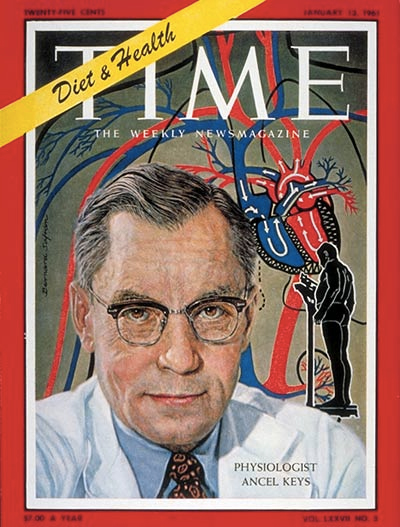
I understand you are familiar with Ancel Keys and his debacles, nevertheless here is a refresher on how he had demonized FATS ideologically as driven by his egomania, politics and conflicting interests.

Time Magazine Front Page: Ancel Keys - Mr. Cholesterol
Image

Dr. Mark Hyman wrote:Before you read any further, you need to know the truth:
Eating Saturated Fat does not cause heart disease.8
I know this might seem startling, given that we’ve spent the better part of a century avoiding everything from butter to egg yolks because we were told they weren’t good for our hearts.
But better to know the truth and make new and healthier habits going forward.

The theory that Fat, and specifically Saturated Fat, is the cause of heart disease all started because of two main findings.
First was that rabbits (which are obviously very different from humans) developed atherosclerosis (fatty deposits in the arteries) when they were fed Cholesterol, which is completely absent from their vegetable diet.
Second, countries that seemed to consume more Saturated Fat and the most Fat generally (for example, Finland and the United States compared to Japan and Greece) had more heart disease.
Since Saturated Fat raised blood levels of Cholesterol, it was assumed that Saturated Fat caused heart disease.
Suddenly, a weak hypothesis that was based on shaky observations, not on any real experiments, was taken as fact.

This idea, spawned in 1953, was the brainchild of a very outspoken, passionate scientist from the University of Minnesota named Ancel Keys.
Many questioned Keys’ scientific conclusions, but he was vigorous in criticizing anyone who challenged him.
He was a dominant, persuasive, and charismatic man who convinced the world of his hypothesis.

The history and failure of Keys’ diet-heart hypothesis, that Fat is bad, is well documented in Nina Teicholz’s book, The Big Fat Surprise.9

Keys made his conclusions based on observations of heart disease, death rates, and Fat consumption in six countries, even though data on twenty-two countries from the Food and Agriculture Organization of the United Nations and data from the World Health Organization (WHO) was available.

The diet record keeping was questionable.
He selected six countries that he felt had the best data (or perhaps that he knew would best support his ideas) and found a direct correlation between the amount of Fat in the diet and heart disease.
He ignored data from the other sixteen countries.

A more recent 2010 review by the Food and Agriculture Organization found that “there is no probable or convincing evidence” that a High-Fat Diet causes heart disease.10
When all twenty-two countries were included in the analysis in 1957 by two who questioned Keys’ conclusions, Drs. Herman Hilleboe, then New York State commissioner of health, and Jacob Yerushalmy, professor of statistics at the University of California, Berkeley, there was zero correlation between Fat in the diet and heart disease.11

Yet despite that fact, and the fact that observational or population studies cannot prove cause and effect, Keys’ study took hold.
There were challenges to Keys' claim but he was quick to demonize whoever challenged his claims with flimsy counters which the 'stupid' [then and even now] accepted.
CHALLENGES TO THE DIET-HEART HYPOTHESIS
One of the voices Keys tried to silence was that of John Yudkin, the British physician and founding professor of the Department of Nutrition at Queen Elizabeth College in London.
Dr. Yudkin was ahead of his time.
Keys promoted his 'manipulated' views in 1953 but in 1984 he did some corrections but it was already too late since the meme was already habituated in the minds of the majority.
Subsequently, in 1984, Keys published a follow-up study that reanalyzed the data and could not find any association between Saturated Fat and heart disease.16
But by that time, the diet-heart hypothesis was so entrenched, policies set, and the food industry mobilized to produce Fat-free (highcarb) foods that there was no going back.

Re: The Philosophy of Obesity

Posted: Sat Feb 05, 2022 9:12 am
by Veritas Aequitas
@sculptor

Here is why CICO has no significant basis regarding Obesity.
Dr. Mark Hyman wrote: Eating Fat Does Not Make You Fat!

If you believe that all calories are created equal (and you now know they definitively are not), then it stands to reason that you’d also be quick to demonize Fat and blame it for weight gain.
It seems like simple math: If Fat has more than twice as many calories per gram as Carbs or Protein, then if you eat less Fat, you will eat fewer calories and lose weight.
Sounds reasonable, doesn’t it?
Unfortunately it just doesn’t work out that way for many reasons.

That all calories are the same in terms of effects on your weight and metabolism is one of the most persistent myths in medicine today.
They are the same in a laboratory, when you burn them in a vacuum.
But not when you eat them.

New public policies require restaurants to list the calorie content of each dish, and food companies to label calories per serving in large, bold type.
But this is the wrong strategy, because it implies that only calories matter.

The truth is that different calories affect your
  • gene expression,
    hormones,
    brain chemistry,
    immune system,
    metabolism, and
    even your gut flora differently.

While it is helpful to track calories in processed and fast food (because they can be so loaded with bad calories)—it can deter you from eating that 1,200-calorie meal—if you eat real food, you don’t need to track calories.

Metabolism is not a math problem.
It’s not about balancing “energy” or Calories In And Calories Out CICO.
If it were, and you ate an additional 100 calories a day, which is about a big bite of food, after a year you would gain ten pounds.
After a decade you would gain one hundred pounds.
This just doesn’t happen.
Even if you were the world record holder in calorie counting, you couldn’t get the math right to control your weight.

That’s why weight and metabolism are not math problems.
The quality of the food you eat matters much more than the quantity.
If food were only about calories, it wouldn’t matter what specific foods you ate, as long as you kept below a certain number of calories.
But it does.
Why?

Food is not just a source of energy or calories.
Food is information.
It contains instructions that affect every biological function of your body.
It is the stuff that controls everything.


Food affects the expression of your genes (determining which ones get triggered to cause or prevent disease) and influences your hormones, brain chemistry, immune system, gut flora, and metabolism at every level.

It works fast, in real time with every bite.
This is the ground breaking science of nutrigenomics.