tapaticmadness wrote: ↑Sat Mar 21, 2020 9:00 am
Veritas Aequitas wrote: ↑Sat Mar 21, 2020 8:21 am
How can art exists without any relation to humans and the human mind?
Are you arguing for the ontological existence of arts?
If you can argue for such, then you would be able to argue for the existence of an ontological God.
Btw, you have not justified your alternative but merely associating 'philosophy' [anything goes] with 'arts' which explain nothing effectively.
Yes, I am arguing for the "ontological existence" of conceptual art. And, Yes, I am able to argue for the existence of the ontological God. I am a theist. And I love philosophical/ontological argument.
You must remember that when I speak of Art, I always say that I am speaking of what today is called
Conceptual Art. There really is no object to look at or listen to in conceptual art. Only the idea is important. I don't know if you have studied conceptual art or not. It, for the most part, follows on the ready-mades of Marcel Duchamp, which you can easily find on Youtube. Obviously conceptual art is not decorative. Only the idea, usually expressed in words, is important. Do ideas depend on the human mind for their existence? Idealists will say they do. I say they don't.
Your 'conceptual Art' grounded on 'concept' is self-refuting.
One need differentiate between 'concept' and 'idea' [philosophical].
Concepts are defined as abstract ideas or general notions that occur in the mind, in speech, or in thought.
They are understood to be the fundamental building blocks of thoughts and beliefs. They play an important role in all aspects of cognition.[1][2] As such, concepts are studied by several disciplines, such as linguistics, psychology, and philosophy, and these disciplines are interested in the logical and psychological structure of concepts, and how they are put together to form thoughts and sentences. The study of concepts has served as an important flagship of an emerging interdisciplinary approach called cognitive science.[3]
wiki - Concepts
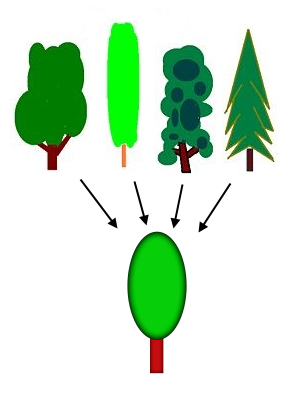
- When the mind makes a generalization such as the concept of tree, it extracts similarities from numerous examples; the simplification enables higher-level thinking.
These similarities for the concept 'tree' are all empirical evident, thus related to the mind. Wherever the concept of tree is directed at, there should be a justifiable real empirical evident tree in existence.
As such you '
conceptual art' by definition has to be mind-interactive cannot be a basis for 'ontological existence'.
Note
idea as in Philosophical Ideas are merely reified things out of crude desperate reason that is not grounded on reality - i.e. empirically and philosophically justifiable reality.
A philosophical idea is a thought in mind that do not have any linkage to anything realistic that can be proven empirically and philosophically.
- For example round and circular shaped things are observed in reality but the mind [crude reason] and inherent psychology extrapolated these actual round and circular shapes to an 'idea' of a perfect circle which is supported by objective measurements.
But such a reasoned 'perfect circle' cannot exists in reality as a real thing. The perfect circle is an illusion as a useful standard.
It is the same idea with the concept of created things which can be justified as real empirically and philosophically and created by a creator, e.g. a created table, an apple planted by a farmer, and the likes, but desperate souls extrapolated such created_thing by creators to the Ultimate creator, i.e. God or the ontological God which is a reification out of an illusory idea [not concepts].
Note the idea of an ontological God is a reification by the desperate mind [psychological] out of desperation to deal with an inherent existential crisis.
Note my argument;
God is an Impossibility
If you are into ontological things [ideas, God, soul] as really real, prove Philosophical Realism is tenable as real.
In metaphysics, [Philosophical] Realism about a given object is the view that this object exists in reality independently of our conceptual scheme.
In philosophical terms, these objects are
ontologically independent of someone's conceptual scheme, perceptions, linguistic practices, beliefs, etc.
https://en.wikipedia.org/wiki/Philosophical_realism
