Ad blocker detected: Our website is made possible by displaying online advertisements to our visitors. Disable your ad blocker to continue using our website.
BigMike wrote: ↑Mon Dec 30, 2024 1:30 am
So here’s the challenge again, spelled out clearly: Name one human trait or quality you believe cannot be explained deterministically.
Okay, how about the "experiencing" of the qualia involving the unique flavor or "taste" of a banana?
In other words, use determinism to describe what it is within the makeup of a human that not only "experiences" (and "enjoys") the unique flavor of a banana, but is also capable of differentiating it from the unique flavor of a pear,...
...of which it "enjoys" to an equal degree, but "prefers" the "taste" of the banana on its morning cereal?
_______
It's enough for Mike to answer this in Chalmers's "Easy problems" sense. It would be unfair to expect determinism to resolve the Hard problem within the Western philosophical framework, when no other philosophy can do that either.
Well, BigMike is the one who asked us to name "...one human trait or quality..." that we believe cannot be explained deterministically.
Anyway, he'll probably just ignore my post.
He doesn't like dealing with actual challenges.
_______
seeds wrote: ↑Sun Dec 29, 2024 8:16 pm
I cannot disprove causality or determinism, nor would I even attempt to challenge the fundamental principles of the laws of conservation, or the four fundamental forces.
No, the simplest thing I can do in this particular situation is to reinvoke the words of Terence McKenna...
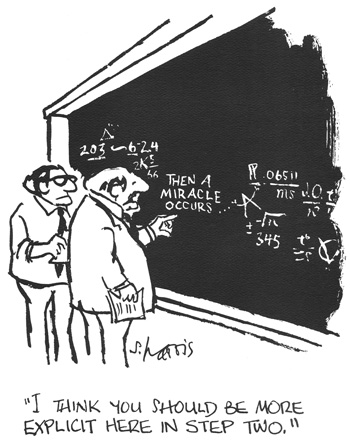
“Modern science is based on the principle ‘Give us one free miracle and we’ll explain the rest.’ The ‘one free miracle’ is the appearance of all the mass and energy in the universe and all the laws that govern it in a single instant from nothing.”
...and then point out to you that your theory of determinism expects us to grant you the "one free miracle" mentioned in the quote.
However, some of us are simply not that generous (or gullible).
No!....
...The quote implodes the moment he says that science is based of the principle of 'give us one free miracle...' since anything naturally occurring is not a miracle whether or not we can explain it at this or any other time.
I'm sorry, Dubious, but despite your proven ability to accurately point out the problems in someone's argument, you've given away the weakness of your hand by using the term "naturally occurring," which, to me, is nothing more than the blind and mindless meanderings of "chance" dressed up in a mother's apron.
As I posed to BigMike, do you, Dubious, actually believe that this,...
...which came "fully stocked" with every possible ingredient and process necessary to awaken untold billions of unique lifeforms into existence,...
...was a "naturally occurring" phenomenon?
Really???
Dubious wrote: ↑Sun Dec 29, 2024 10:47 pm
But, for the sake of argument, let's use the word 'miracle' as employed in the quote. Now what? Does it in any way confute the fact that all the laws that govern as ramifications of this so-called miracle are by that very definition deterministic...whether or not you call it a miracle?
Likewise, for the sake of argument, if I were to concede to you and BigMike that determinism was indeed probably involved in most of the material processes that culminated in the manifestation of the human brain,...
...will you guys at least be open to the "possibility" that the human "I Am-ness" of which the brain has metaphorically "given birth" to,...
...could be an epiphenomenal "something" that,...
...in the spirit of what "strong emergence" allegedly entails,...
...represents something that is "wholly other" than that which it emerged from?
I'm talking about a "self-aware something" that, within the autonomous domain of its own personal mind, possesses the absolute "free will" ability to shape its own personal supply of mental imaging energy into absolutely anything it freely chooses?
Again, you guys can have your determinism up to - but not beyond the point - where the human mind, along with its accompanying "I Am-ness," is, again, metaphorically "born" (strongly emerges) from the quantum fabric of the brain.
Now I know it sounds far-fetched, but what I am speculatively suggesting is that the ontological status of the human mind (relative to the material fabric of the brain) is not unlike what is suggested as being the status of the parallel worlds in the "Many Worlds Interpretation of Quantum Mechanics."
In other words, the emergence of the human mind ("I Am-ness"/soul) from the quantum fabric of the brain is like a new parallel universe that "branches" off of this universe in such a way where the inner physics of the mind is no longer connected to (entangled with) the physics of the universe it branched off of.
In which case, our minds thus acquire full autonomy where the inner "agent" has "free will" control over its own inner dimension of reality without effecting or impinging on the physics of other parallel universes.
(Yeah, yeah, I know, poor ol' Hugh Everett and Bryce DeWitt are probably spinning in their graves right now. But you can't say that I'm not trying to incorporate "science" [albeit "pseudo" science] into my argument. )
Dubious wrote: ↑Sun Dec 29, 2024 10:47 pm
When an absurd statement is made it usually proves opposite to its intended effect. Mr. Mckenna should have used fewer psychedelics to swarm his neurons in making the wrong connections.
Well, has Mr. Dubious personally experimented with psychedelics and therefore has first-hand knowledge of that which he warns of?
Furthermore, Mr. Mckenna isn't the only person to express the particular sentiment stated in that quote...
I suppose you'll insist that the person who created that cartoon should stick to cartooning and leave the brainy stuff to the math nerds, right?
_______
promethean75 wrote: ↑Mon Dec 30, 2024 2:03 am
"If you truly believe determinism is fundamentally flawed, then you should be able to articulate why, in clear terms"
Well, a long time ago, when i was a PN newb i had to sort everyone out about that very thing. I do believe they summarily dismissed my thesis.
The outstanding problem for the theory of determinism is that it can't be falsified empirically, something Hume was getting at indirectly with his contiguity of events premise; all we experience are events following each other in sequence but nothing demonstrates that any of these events in sequence cause those that come after them. There is no logical connection between A and B. Even if B persistently follows A.
That being said, neither is the theory of freewill empirically falsifiable or verifiable (which is redundant because verifiability is granted for any falsifiability).
Moreover, the alternative theory to... let's call it Hume's theory of Leibniz's spontaneous monadic causality... would be even more strange than a mundane theory of physical force causation through the simple transfer of energy (objects bumping into objects causing them to move).
In other words, it would be easier to explain ball B moving when ball A hits it because ball A's intertia and mass and momentum was such that it caused ball B to move than it would be to say ball A had nothing to do with making ball B move. Ball B made itself move... and it did it every single time ball A hit it just to f*** with you.
And that being the case, we go back to Big Mikean determinism even though it isn't falsifiable via Hume, and the alternative theory to explain motion (from particles to neurons to galaxies) would be even more bonkers than Big Mikean determinism is.
Promethean75,
You bring up a great point about falsifiability and Hume’s skepticism regarding causation, and I appreciate the way you’ve outlined the challenge. Let me clarify how I use determinism, which I talk about as shorthand for something much more grounded: the conservation laws and the four fundamental interactions. These aren’t abstract philosophical constructs—they’re the bedrock of how everything in the universe operates. When I discuss causation, I mean it in terms of interactions that are directly tied to these physical principles.
Causation, in my view, is not a one-way street. It’s an interaction. What one object gains—energy, momentum, charge, etc.—the other loses. Conservation laws govern this, ensuring there’s always a reciprocal exchange. Every action has an equal and opposite reaction. When two objects collide, they "cause" changes in each other’s state. This interplay of forces, energy, and matter is observable, measurable, and predictive.
The criticism that determinism isn’t empirically falsifiable because we only observe events in sequence misunderstands how determinism is applied in physics. Yes, Hume pointed out that causation as we perceive it is based on the constant conjunction of events, but the conservation laws provide a much deeper mechanism. For instance, if ball A collides with ball B and transfers momentum, we can measure the precise distribution of energy and momentum post-collision. These measurements confirm that conservation principles hold, every single time, under all conditions we’re capable of testing. It’s not just that B moves because A hit it—it’s that the energy and momentum from A are necessarily transferred to B in a way that obeys the governing equations of motion.
Your point about alternative theories is crucial. If we reject determinism as an explanation for motion, we’re left with explanations that are not just less plausible—they’re downright absurd. The idea that ball B moves spontaneously, independent of any physical interaction with ball A, would break the conservation laws. It would require introducing forces or interactions that defy all current understanding of physics. That’s not just "bonkers," as you put it—it’s a complete departure from observable reality.
So while it’s true that determinism, as an overarching philosophical framework, might not be falsifiable in Hume’s strict sense, the physical principles it’s built on—like conservation laws—are as close to falsifiability as science gets. And the alternative explanations for causation that would arise in a world without determinism aren’t just strange—they’re inconsistent with everything we observe.
The bottom line is this: determinism isn’t an abstract belief; it’s an extension of the fundamental principles that govern interactions. It’s not about assuming causation—it’s about observing and measuring the interplay of forces and changes that make up every aspect of reality. If someone wants to challenge that, they need an alternative explanation for why these laws hold every time, everywhere. So far, no one’s come close.
BigMike wrote: ↑Mon Dec 30, 2024 1:30 am
If you truly believe determinism is fundamentally flawed (…)
Insofar as it pertains to a man’s free choices, yet within conditioned circumstances, your interpretation of determinism’s consequences seem flawed to me.
I would say that the doctrines you have established and purvey show notable flaws. I have spoken of this already …
Does that help any?
If you’re so convinced that determinism is reductionist and inadequate, prove it.
You have been reading badly. I largely accept determinism in the unfolding of the cosmos. I accept determinism in man’s world if it is modified to “conditioning”. I give an agency to man that you deny, and believe that man can access a higher dimension (through mechanism I cannot fathom or explain).
I do believe that everything we do is constructed on what is in a linear order (this is intuitive). So I think I get your fixation on what has been determined.
I think that what Promethean just submitted (he always surprises, doesn’t he?) could be useful to your understanding.
Alexis,
You claim to accept determinism "in the unfolding of the cosmos" and even in "man’s world if modified to conditioning," yet you continue to cling to an undefined notion of "agency" that supposedly escapes deterministic principles. Let me clarify how agency fits within my deterministic framework and why it doesn’t conflict with human experience or the broader implications of causality.
Agency is often understood as the capacity to act or intervene in the present to produce a specific effect. My view modifies this understanding in a crucial way: agency isn’t about free, independent action in the present—it’s about how learning and memory open the door to action or intervention that produces a particular effect in the future. In other words, agency isn’t negated by determinism; it is enhanced by it. The brain, shaped by experience and input, learns, adapts, and stores information through physical changes at the neural level. These changes enable future actions that are informed by past experiences.
Let’s consider an example: Suppose someone chooses to learn a musical instrument. The effort they invest—repeating scales, understanding rhythm, practicing coordination—leads to physical changes in the brain. Synaptic connections are strengthened, motor skills improve, and memory consolidates these experiences. These deterministic processes set the stage for future choices and actions: improvising a melody, playing in an orchestra, or teaching others. The "agency" you attribute to something transcendent is better understood as the deterministic interplay of past learning, present conditions, and future potential.
This doesn’t diminish human agency—it grounds it in a reality that is observable, measurable, and consistent with the laws of nature. Far from reducing human experience to mechanistic inevitability, it highlights the extraordinary adaptability and complexity of deterministic systems. Our choices, as you call them, are not less meaningful because they arise from these processes. They are more meaningful because they are the cumulative result of everything we’ve learned, remembered, and experienced.
When you speak of "accessing a higher dimension" or "free choices within conditioned circumstances," you sidestep explaining how these notions fit with the physical reality of how humans act and learn. If you grant that human behavior operates within a deterministic framework of conditioning, then your idea of "agency" must be reconciled with the fact that every choice we make is informed by the deterministic interplay of our biology, experiences, and environment.
This is why your claim that my interpretation of determinism is flawed rings hollow. You haven’t shown how your concept of "agency" functions in practice, or how it adds anything to our understanding of human action that determinism doesn’t already explain. If you believe there is something fundamentally missing from this view, then demonstrate it. Otherwise, your insistence on a transcendent or unexplained "agency" feels more like a placeholder for the gaps in your own framework than a substantive critique of mine.
Agency, in my view, is about creating a future informed by the past through mechanisms we understand: learning, memory, and adaptation. If you think there’s more to it, then explain what and how. Otherwise, your criticisms of determinism lack the coherence needed to be taken seriously.
seeds wrote: ↑Mon Dec 30, 2024 2:19 am
Okay, how about the "experiencing" of the qualia involving the unique flavor or "taste" of a banana?
In other words, use determinism to describe what it is within the makeup of a human that not only "experiences" (and "enjoys") the unique flavor of a banana, but is also capable of differentiating it from the unique flavor of a pear,...
...of which it "enjoys" to an equal degree, but "prefers" the "taste" of the banana on its morning cereal?
_______
It's enough for Mike to answer this in Chalmers's "Easy problems" sense. It would be unfair to expect determinism to resolve the Hard problem within the Western philosophical framework, when no other philosophy can do that either.
Well, BigMike is the one who asked us to name "...one human trait or quality..." that we believe cannot be explained deterministically.
Anyway, he'll probably just ignore my post.
He doesn't like dealing with actual challenges.
_______
I prefer the flavour and texture of a pear because I learned to do so as a young child influenced by my mother and no doubt by wartime unavailability of bananas. Please see the word 'because' which indicates the conditional clause and its use in everyday reasoning.
seeds wrote: ↑Sun Dec 29, 2024 8:16 pm
I cannot disprove causality or determinism, nor would I even attempt to challenge the fundamental principles of the laws of conservation, or the four fundamental forces.
No, the simplest thing I can do in this particular situation is to reinvoke the words of Terence McKenna...
...and then point out to you that your theory of determinism expects us to grant you the "one free miracle" mentioned in the quote.
However, some of us are simply not that generous (or gullible).
No!....
...The quote implodes the moment he says that science is based of the principle of 'give us one free miracle...' since anything naturally occurring is not a miracle whether or not we can explain it at this or any other time.
I'm sorry, Dubious, but despite your proven ability to accurately point out the problems in someone's argument, you've given away the weakness of your hand by using the term "naturally occurring," which, to me, is nothing more than the blind and mindless meanderings of "chance" dressed up in a mother's apron.
As I posed to BigMike, do you, Dubious, actually believe that this,...
...which came "fully stocked" with every possible ingredient and process necessary to awaken untold billions of unique lifeforms into existence,...
...was a "naturally occurring" phenomenon?
Really???
Dubious wrote: ↑Sun Dec 29, 2024 10:47 pm
But, for the sake of argument, let's use the word 'miracle' as employed in the quote. Now what? Does it in any way confute the fact that all the laws that govern as ramifications of this so-called miracle are by that very definition deterministic...whether or not you call it a miracle?
Likewise, for the sake of argument, if I were to concede to you and BigMike that determinism was indeed probably involved in most of the material processes that culminated in the manifestation of the human brain,...
...will you guys at least be open to the "possibility" that the human "I Am-ness" of which the brain has metaphorically "given birth" to,...
...could be an epiphenomenal "something" that,...
...in the spirit of what "strong emergence" allegedly entails,...
...represents something that is "wholly other" than that which it emerged from?
I'm talking about a "self-aware something" that, within the autonomous domain of its own personal mind, possesses the absolute "free will" ability to shape its own personal supply of mental imaging energy into absolutely anything it freely chooses?
Again, you guys can have your determinism up to - but not beyond the point - where the human mind, along with its accompanying "I Am-ness," is, again, metaphorically "born" (strongly emerges) from the quantum fabric of the brain.
Now I know it sounds far-fetched, but what I am speculatively suggesting is that the ontological status of the human mind (relative to the material fabric of the brain) is not unlike what is suggested as being the status of the parallel worlds in the "Many Worlds Interpretation of Quantum Mechanics."
In other words, the emergence of the human mind ("I Am-ness"/soul) from the quantum fabric of the brain is like a new parallel universe that "branches" off of this universe in such a way where the inner physics of the mind is no longer connected to (entangled with) the physics of the universe it branched off of.
In which case, our minds thus acquire full autonomy where the inner "agent" has "free will" control over its own inner dimension of reality without effecting or impinging on the physics of other parallel universes.
(Yeah, yeah, I know, poor ol' Hugh Everett and Bryce DeWitt are probably spinning in their graves right now. But you can't say that I'm not trying to incorporate "science" [albeit "pseudo" science] into my argument. )
Dubious wrote: ↑Sun Dec 29, 2024 10:47 pm
When an absurd statement is made it usually proves opposite to its intended effect. Mr. Mckenna should have used fewer psychedelics to swarm his neurons in making the wrong connections.
Well, has Mr. Dubious personally experimented with psychedelics and therefore has first-hand knowledge of that which he warns of?
Furthermore, Mr. Mckenna isn't the only person to express the particular sentiment stated in that quote...
I suppose you'll insist that the person who created that cartoon should stick to cartooning and leave the brainy stuff to the math nerds, right?
_______
But God did not create everything, every event, from nothing but from God itself. There is no miracle but there is system. Determinism is system. You are not understanding determinism if you think it's nothing more than A follows B.
Constant conjunction is analytical thinking, good in its proper context but insufficient for metaphysics.
promethean75 wrote: ↑Mon Dec 30, 2024 12:28 am
"Name one human trait, quality, or experience that you believe cannot be fully described or explained within the deterministic framework I’ve laid out. Just one."
A French physicist falls into a hadron collider, is converted into a laser beam, and fired at a double slit in a sheet of metal. The physicist reports having passed through both slits unless and only if one of the other physicists looked at him.
Alright, promethean75, let’s proceed as planned. You’ve brought up a classic quantum mechanics scenario wrapped in poetic humor—a physicist as a conscious particle navigating the double-slit experiment. Now it’s your turn to lay out the explanation and description of this "trait, quality, or experience" in the context you’ve proposed.
BigMike wrote: ↑Sun Dec 29, 2024 11:14 pm
Here’s how we’ll proceed: You’ll describe and explain that trait from your perspective, with all the metaphysical and poetic flourishes you need. I’ll then describe and explain it fully, based entirely on my deterministic worldview. Let’s see whose explanation stands up to scrutiny. Let’s see whose framework is clearer, more coherent, and grounded in reality.
Take your time to describe it fully, with all the metaphysical and poetic elements you need. Afterward, I’ll respond, framing it entirely within my deterministic worldview. My goal will be to ground the phenomenon—be it consciousness, observation, or quantum behavior—in the four fundamental interactions and conservation laws, as they govern all processes in the universe.
Let’s see which framework—yours or mine—holds up under scrutiny.
The French physicist is also in a big box that has a trigger, which will raise a mirror to deflect him (he's the laser beam, remember) if a cecium particle decays and this will kill him. Well, there's a quantum unit of time in which he's both deflected by the mirror, and he's not. Only if one of the other physicists turns the cam on inside the box before the particle decays will the French physicist be either alive or dead. If he keeps the cam off, the physicist is in both states; deflected by the mirror and therefore dead and passing through the double slit unobserved in an indeterminate state (unless one of the physicists looks at the target canvas the physicist hits after passing through the slits).
Ergo, the French Schrödinger's laser-man in a box is faced with a fundamental problem pertaining to the true ontological nature of his existing state. It seems he is indeed in more than one state at a time... and this complicates the relationship between the associated causal event chains that determine the outcome of events. How can dude be alive and dead at the same time, and how can he pass through both slits... but not if somebody sees him? These are the questions that raise concern for myself and my colleagues, BigMike.
promethean75 wrote: ↑Mon Dec 30, 2024 1:29 pm
The French physicist is also in a big box that has a trigger, which will raise a mirror to deflect him (he's the laser beam, remember) if a cecium particle decays and this will kill him. Well, there's a quantum unit of time in which he's both deflected by the mirror, and he's not. Only if one of the other physicists turns the cam on inside the box before the particle decays will the French physicist be either alive or dead. If he keeps the cam off, the physicist is in both states; deflected by the mirror and therefore dead and passing through the double slit unobserved in an indeterminate state (unless one of the physicists looks at the target canvas the physicist hits after passing through the slits).
Ergo, the French Schrödinger's laser-man in a box is faced with a fundamental problem pertaining to the true ontological nature of his existing state. It seems he is indeed in more than one state at a time... and this complicates the relationship between the associated causal event chains that determine the outcome of events. How can dude be alive and dead at the same time, and how can he pass through both slits... but not if somebody sees him? These are the questions that raise concern for myself and my colleagues, BigMike.
Ah, promethean75, I appreciate the creativity here—Schrödinger’s laser-man brings a fresh twist to the quantum puzzle. But let’s dig in.
The scenario you describe hinges on quantum superposition, observer effects, and the apparent paradox of being in multiple states simultaneously. It’s fascinating, no doubt, but it doesn’t undermine determinism. Here’s why:
1. Superposition is Determined by the Wave Function: The physicist-laser exists in a superposition of states—alive and dead, deflected and not deflected—until observation. This doesn’t mean causation breaks down. The wave function evolves deterministically according to the Schrödinger equation, describing all possible states and their probabilities.
2. Observer Effect is Causal: The collapse of the wave function when observed is not magic; it’s a physical interaction. The act of measurement itself is a causal event, governed by quantum rules. What appears indeterminate is a reflection of our probabilistic predictions, not a refutation of causality.
3. Alive and Dead? Only Until Measured: The physicist is not truly alive and dead simultaneously in a meaningful ontological sense. Instead, the superposition reflects potential outcomes based on initial conditions and quantum probabilities. Once observed, the state resolves in a manner fully consistent with the deterministic framework of quantum mechanics.
4. Causal Chains Remain Intact: Even in the quantum realm, every effect has a cause. The apparent randomness at the quantum level does not negate determinism but shifts it to the probabilistic domain. The outcomes of measurements are constrained by the underlying rules and initial conditions.
So, while the French laser-man might spark philosophical musings, the deterministic worldview stands firm. The entire quantum scenario you’ve outlined is fully explainable within this framework—no metaphysical mysteries required.
Now it’s your turn to either challenge my explanation or refine your own. Let’s keep the conversation illuminating!
promethean75 wrote: ↑Mon Dec 30, 2024 12:28 am
A French physicist falls into a hadron collider, is converted into a laser beam, and fired at a double slit in a sheet of metal. The physicist reports having passed through both slits unless and only if one of the other physicists looked at him.
Although I approve of using the French for gruesome experiments (excellent choice, you are wise and have good taste), I suspect this scenario is impossible. You can't meet a physicist who tells you he passed through both slits, because by meeting him he decohered to the classical world, along with his past and his memories. I think. Not 100% sure.
BigMike wrote: ↑Mon Dec 30, 2024 10:10 amYou claim to accept determinism "in the unfolding of the cosmos" and even in "man’s world if modified to conditioning," yet you continue to cling to an undefined notion of "agency" that supposedly escapes deterministic principles. Let me clarify how agency fits within my deterministic framework and why it doesn’t conflict with human experience or the broader implications of causality.
Agency is often understood as the capacity to act or intervene in the present to produce a specific effect. My view modifies this understanding in a crucial way: agency isn’t about free, independent action in the present—it’s about how learning and memory open the door to action or intervention that produces a particular effect in the future. In other words, agency isn’t negated by determinism; it is enhanced by it. The brain, shaped by experience and input, learns, adapts, and stores information through physical changes at the neural level. These changes enable future actions that are informed by past experiences.
First, the notion of determinism is, for those of us introduced to basic physics concepts, intuitively obvious. What I accept about the deterministic view is that we — living beings — have our existence in a world where everything going on there is outside of our control. Whatever we are is conditioned, determined in your sense, by the fact that anything that happens in that world is part of a world-process — and we are “chained”, bound into the conditioned processes and patterns. We are, in this sense, parts-and-parcels of a process and we are pushed along in a manner similar to a wave that is cresting.
I am not closed to your image of a water molecule swept along and literally absent agency. I think that this is what you have been trying to communicate, and I think I captured the sense of this view long ago, when I first pondered what *determinism* meant.
If I understand your view correctly, I believe that you would say that no matter what a man does, it occurs within the framework, the conditionality, of an ongoing — and determining — process. So, even if a man holds the belief that what he does — some action, any action — is done as a result of *free choice*, the fact is that he only acts from within a conditioned framework, and in order to act must employ physical energy in that choice. There is no action, on any level, that can avoid or somehow escape the *reality* of existing within that framework.
There is no man who exists outside of the framework of biological and physical life, so there is no man with access to any perspective of what it could be to operate, let’s say, supernaturally. I only mean here operating outside of nature and natural processes.
Seen in this way there would be no way to say, to declare, nor to believe, that man is *free* of determining principles. It is logically impossible given the structure, the confining structure of his *being in the world*.
So, I believe that I understood right from the start — again if I have fairly paraphrased what you do believe — how it is that you are seeing man.
Dubious has put it like this:
Everything you believe is a demonstration of determinism, not its exception. What other reality can it detour into other than the one it derives from? There are not two realities, one physical, the other metaphysical. There is only the one which hosts the complete set of everything that was made possible from the beginning which we interpret and separate into its various components epistemologically. Within determinism, subjectivity is as valid an outcome as anything objectively determined. It's just a matter of how its layers are interpreted.
Now, what I have said — what I did say right at the beginning — is that in my sense of the word *agency* I do not mean simply a choice to move from point A to point B nor do I define choice as the rebellious decision to go against the grain and go to C instead of B because one is *truly free* and I have a divine power, but rather I used the phrase *We have a cubic centimeter of a chance* to bring into our world, or if you will to *move atoms* in our world, from within our consciousness or our psyche, by access to a potency that exists outside of the confines of time & space and *material entanglement*. By material entanglement I mean many different things (it contains an allusion to disentanglement) but for the time being I’ll leave it at that.
In my view — and because we can conceive of it — we can in one degree or another access that potency that is not, like us, chained within material processes like that molecule of water.
But it must be noted that in your world, the world you define through a philosophy and also an ideology that you are constructing upon the physics principles which you declare as being inviolable (and I do not deny that these dominate), you have chosen, or perhaps you have been determined, not to be able to conceive of any potency, a potency, that exists outside of the causal domain. For this reason (I gather) you honestly define yourself as an atheist.
You have seen no evidence of anything that moves in our world in some way as outside of physical processes. Even or perhaps especially what is *epiphenomenal* is simply what is emergent from the vast possibilities of interrelationship in the neuronal complex. And I think that you would say that, mathematically, the possibilities in *combinations* could only be expressed with some giant, almost incomprehensible number.
Atla wrote: ↑Mon Dec 30, 2024 5:47 am
Be honest, doesn't it bother you that there are countless different traditions on this planet that rely on subjective experience with the divine, and you can't objectively show that yours is the correct one, nor that it isn't made up?
What you refer to as *made up* I modify with the term interpret. Different traditions, in my view, definitely construct (pull together, assemble) complex symbols and this is an interpretive process.
Buzzing little pockets of 'energy' that have somehow found a way to give 'meaning' to their existence. The ultimate storytellers. It's quite touching actually
Clearin' virtual detritus as part of the year's end ritual -- out with the old, in with the new -- I happened on this essay in a little-accessed file. I have a dim recollection of posting it once, many moons back, in some now-defunct thread. Seems appropriate (in light of certain, in-thread, positions) to post it again, here, in this soon-to-be-defunct thread... note: this is a cut & paste...I had to reconstruct the formatting...any flaws or errors belong to me, not Machan
-----
A Brief Defense of Free Will
by Tibor Machan
The Importance of Having Free Will
This is not a common topic of discussion outside the discipline of philosophy and some other fields. Nevertheless, political economy is related to this philosophical problem in more ways than one. For example, if, say, a certain system of law is just, it is implied that we ought to implement it—even if only gradually, over time. If we claim that aggression is wrong, we implicitly hold that people ought to refrain from it. Indeed, even to say that some argument concerning any topic from logic to astronomy is unsound, we are claiming, implicitly, that one ought not to propose or accept it.
But as the philosopher Immanuel Kant pointed out, "ought implies can." That means, in part, that only if it is possible to choose to do something can it be the case that it ought to be done. So the very meaningfulness of the advocacy of political ideals implies that free will exists. (The other meaning of "ought implies can" is that some objective standard of human conduct must be identifiable, otherwise one could never do what one ought to do.)
Thus, clearly, it is of some value to explore briefly whether human beings have free will. In connection with the particular principles of classical liberalism, the issue of why respecting individual rights is vital and possible relates to the problem of free will. Individual rights need to be respected because we must have an area of personal responsibility within which to make our choices about our lives or wherein to initiate our own actions. The need for this kind of respect assumes, again, that human beings have free will, that they can make basic choices about their lives, initiate basic conduct, that can turn out to be right or wrong. Furthermore, requiring of people that they respect individual rights also assumes that they possess free will. Otherwise it would make no sense to require such respect from them: something they have no choice about cannot be something they morally ought to and can fail to do.
But there is also the more familiar matter of the issue of personal responsibility concerning everyday conduct, those matters discussed daily in the home, in the press, and on the various media. Not only is there the issue of who is responsible for various good and bad things, but there is also the question of whether most of us are, as so many people seem to believe, in the grips of various forces over which we have no control. This or that addiction—to drugs, sex, violence, power, athletics, or work—is supposed to be our master, with ourselves merely puppets on strings moved about by them.
Yet, only if we have free will does any talk of blaming our parents, politicians, the rich, bureaucrats and the rest make sense. But there are many people who believe that modern science, including, of course, all the social sciences, leave no room for such a thing in human life. Where does it stand, then, with the free will issue? It seems to me worth discussing this topic outside the confines of philosophy graduate seminars and encourage some thinking about it on everyone's part. After all, it is a central feature of the political philosophy of liberty that individual citizens in society must not be thwarted in making choices for themselves, in initiating their own thinking and conduct. What does this come to unless they possess free will, the capacity to produce their own behavior?
I want to argue that there is indeed free will. And I'm going to defend the position that free will means that human beings can cause some of what they do, on their own; in other words, what they do is not explainable solely by references to factors that have influenced them, though, of course, their range of options is clearly circumscribed by the world in which they live, by their particular circumstances, capacities, options, talents, etc. My thesis, in other words, is that human beings are able to cause their actions and they are therefore responsible for some of what they do. In a basic sense we are all are original actors capable of making novel moves in the world. We are, in other words, initiators of some of our behavior.
The first matter to be noted is that this view is in no way in contradiction to science. Free will is a natural phenomenon, something that emerged in nature with the emergence of human beings, with their kind of minds, namely, minds that can think and be aware of their own thinking.
Nature is complicated and multifaceted. It includes many different sorts of things and one of these is human beings. Such beings exhibit one unique yet natural attribute that other things apparently do not exhibit and that is free will.
I am going to offer eight reasons why a belief in free will makes very good sense. Four of these explain why there can be free will - i.e., why nature does not preclude it. But these do not yet demonstrate that free will exists. That will be the job of the four reasons I will advance next, which will establish that free will actually exists, it's not just a possibility but an actuality.
Nature's Laws Versus Free Will
First, one of the major objections against free will is that nature is governed by a set of laws, mainly the laws of physics. Everything is controlled by these laws and we human beings are basically more complicated versions of material substances and that therefore whatever governs any other material substance in the universe must also govern human life. Basically, we are subject to the kind of causation everything else is. Since nothing else exhibits free will but conforms to causal laws, so must we be. Social science is merely looking into the particulars of those causes, but we all know that we are subject to them in any case. The only difference is that we are complicated things, not that we are not governed by the same principles or laws of nature.
Now, in response I want to point out that nature exhibits innumerable different domains, distinct not only in their complexity but also in the kinds of beings they include. So it is not possible to rule out ahead of time that there might be something in nature that exhibits agent causation. This is the phenomenon whereby a thing causes some of its own behavior. So there might be in nature a form of existence that exhibits free will. Whether there is or is not is something to be discovered, not ruled out by a narrow metaphysics that restricts everything to being just a variation on just one kind of thing. Thus, taking account of what nature is composed of does not at all rule out free will. Yet, simply because of the possibility that there is free will, there may still not be. We consider that a bit later.
Can We Know of Free Will?
Now, another reason why some think that free will is not possible is that the dominant mode of studying, inspecting or examining nature is what we call "empiricism. " In other words, many believe that the only way we know about nature is we observe it with our various sensory organs. But since the sensory organs do not give us direct evidence of such a thing as free will, there really isn't any such thing. Since no observable evidence for free will exists, therefore free will does not exist.
But the doctrine that empiricism captures all forms of knowing is wrong —many things that we know not simply through observation but through a combination of observation, inferences, and theory construction. (Consider, even the purported knowledge that empiricism is our form of knowledge is not "known" empirically!)
For one, many features of the universe, including criminal guilt, are detected without eyewitnesses but by way of theories which serve the purpose of best explaining what we do have before us to observe. This is true, also, even in the natural sciences. Many of the phenomena or facts in biology, astrophysics, subatomic physics, botany, chemistry—not to mention psychology—consist of not what we see or detect by observation but that is inferred by way of a theory. And the theory that explains things best—most completely and most consistently—is the best answer to the question as to what is going on.
Free will may well turn out to be in this category. In other words, free will may not be something that we can see directly, but what best explains what we do see in human life. This may include, for example, the many mistakes that human beings make in contrast to the few mistakes that other animals make. We also notice that human beings do all kinds of odd things that cannot be accounted for in terms of mechanical causation, the type associated with physics. We can examine a person's background and find that some people with bad childhoods turn out to be decent, whole others crooks. And free will comes as a very helpful explanation. For now all we need to consider that this may well be so, and if empiricism does not allow for it, so much the worse for empiricism. One could know something because it explains something else better than any alternative. And that is not strict empirical knowledge.
Is Free Will Weird?
Another matter that very often counts against free will is that the rest of beings in nature do not exhibit it. Dogs, cats, lizards, fish, frogs, etc., have no free will and therefore it appears arbitrary to impute it to human beings. Why should we be free to do things when in the rest of nature lacks any such capacity? It would be an impossible aberration.
The answer here is similar to what I gave earlier. To wit, there is enough variety in nature—some things swim, some fly, some just lie there, some breathe, some grow, while others do not; so there is plenty of evidence of plurality of types and kinds of things in nature. Discovering that something has free will could be yet another addition to all the varieties of nature.
Let us now consider whether free will actually does exist. I'm going to offer four arguments in support of an affirmative answer.
Are We Determined to Be Determinists—Or Not?
There is an argument against determinism to the effect that, if we are fully determined in what we think, believe, and do, then of course the belief that determinism is true is also a result of this determinism. But the same holds for the belief that there determinism is false. There is nothing you can do about whatever you believe - you had to believe it. There is no way to take an independent stance and consider the arguments unprejudiced because all various forces making us assimilate the evidence in the world just the way we do. One either turns out to be a determinist or not and in neither case can we appraise the issue objectively because we are predetermined to have a view on the matter one way or the other.
But then, paradoxically, we'll never be able to resolve this debate, since there is no way of obtaining an objective assessment. Indeed, the very idea of scientific or judicial objectivity, as well as of ever reaching philosophical truth, has to do with being free. Thus, if we're engaged in this enterprise of learning about truth and distinguishing it from falsehood, we are committed to the idea that human beings have some measure of mental freedom.
Should We Become Determinists?
There's another dilemma of determinism. The determinist wants us to believe in determinism. In fact, he believes we ought to be determinists rather than believe in this myth called "free will". But, as the saying goes in philosophy, "ought" implies "can". That is, if one ought to believe in or do something, this implies that one has a choice in the matter; it implies that we can make a choice as to whether determinism or the free will is a better doctrine. That, then, it assumes that we are free. In other words, even arguing for determinism assumes that we are not determined to believe in free will or determined but that it is a matter of our making certain choices about arguments, evidence, and thinking itself. That's a paradox which troubles a deterministic position.
We Often Know We Are Free!
In many contexts of our lives introspective knowledge is taken very seriously. When you go to a doctor and he asks you, "Are you in pain?" and you say, "Yes," and he says "Where is the pain?" and you say, "It's in my knee," the doctor doesn't say, "Why, you can't know, this is not public evidence, I will now get verifiable, direct evidence where you hurt." In fact your evidence is very good evidence. Witnesses at trials give evidence as they report about what they have seen, which is introspective evidence: "This indeed is what I have seen or heard." Even in the various sciences people report on what they've read on surveys or seen on gauges or instruments. Thus they are giving us introspective evidence.
Introspection is one source of evidence that we take as reasonably reliable. So what should we make of the fact that a lot of people do say things like, "Damn it, I didn't make the right choice," or "I neglected to do something." They report to us that they have made various choices, decisions, etc., that they intended this or that but not another thing. And they often blame themselves for not having done something, thus they report that they are taking responsibility for what they have or haven't done.
In short, there is a lot of evidence from people all around us of the existence of free choice.
Modern Science Discovers Free Will!
Finally, there is also the evidence of the fact that we do seem to have the capacity for self-monitoring. The human brain has a kind of structure that allows us to, so to speak, to govern ourselves. We can inspect our lives, we can detect where we're going, and we can, therefore, change course. And the human brain itself makes it possible. The brain, because of its structure, can monitor itself and as a result we can decide whether to continue in a certain pattern or to change that pattern and go in a different direction. That is the sort of free will that is demonstrable. At least some scientists, for example Roger W. Sperry—in his book Science and Moral Priority (Columbia University Press, 1983) and in numerous more technical articles—maintain that there's evidence for free will in this sense. This view depends on a number of points I have already mentioned. It assumes that there can be different causes in nature, so that the functioning of the brain would not be a kind of self-causation. The brain as a system would have to be able to cause some things about the organism's behavior and that depends, of course, on the possibility of there being various kinds of causes.
Precisely the sort of thing Sperry thinks possible is evident in our lives. We make plans and revise them. We explore alternatives and decide to follow one of these. We change a course of conduct we have embarked upon, or continue with it. In other words, there is a locus of individual self responsibility that is evident in the way in which we look upon ourselves, and the way in which we in fact behave.
Some People Are, Some Are Not Determined
There clearly are cases of conduct in which some persons behave as they do because they were determined to do so by certain identifiable forces outside of their own control. A brain tumor, a severe childhood trauma or some other intrusive force sometimes incapacitates people. This is evident in those occasional cases when a person who engaged in criminal behavior is shown to have had no control over what he or she did. Someone who actually had no capacity to control his or her behavior, could not control his or her own thinking or judgment and was, thus, moved by something other than his own will, cannot be said to possess a bona fide free will.
Those who deny that we have free will simply cannot make sense of our distinction between cases in which one controls one's behavior and those in which one is being moved by forces over which he or she has no control. When we face the latter sort of case, we still admit that the behavior could be good or bad but we deny that it is morally and legally significant—it is more along lines of acts of nature or God by being out of the agent's control. This is also why philosophers who discuss ethics but deny free will have trouble distinguishing between morality and value theory—e.g., utilitarians, Marxists.
The Best Theory is True
Finally, there what I have alluded to earlier, namely, that when we put all of this together we get a more sensible understanding of the complexities of human life than otherwise—we get a better understanding, for example, of why social engineering and government regulation and regimentation do not work, why there are so many individual and cultural differences, why people can be wrong, why they can disagree with each other, etc. It is because they are free to do so, because they are not set in some pattern the way cats and dogs and orangutans and birds tend to be.
In principle, all of the behavior of these creatures around us can be predicted because they are not creative in a sense that they originate new ideas and behavior, although we do not always know enough about the constitution of these beings and how it would interact with their environment to actually predict what they will do. Human beings produce new ideas and these can introduce new kinds of behavior in familiar situations. This, in part, is what is meant by the fact that different people often interpret their experiences differently. Yet, we can make some predictions about what people will do because they often do make up their minds in a given fashion and stick to their decision over time. This is what we mean when we note that people make commitments, possess integrity, etc. So we can estimate what they are going to do. But even then we do not make certain predictions but only statistically significant ones. Clearly, very often people change their minds and surprise or annoy us. And, if we go to different cultures, they'll surprise us even more. This complexity, diversity, and individuation about human beings is best explained if human beings are free than if they are determined.
Is Free Will Well Founded?
So these several reasons provide a kind of argumentative collage in support of the free will position. Can anyone do better with this issue? I don't know. I think it's best to ask only for what is the best of the various competing theories. Are human beings doing what they do solely as the consequences of forces acting on them? Or do they have the capacity to take charge of their lives, often neglect to do so properly or effectively, make stupid choices? Which supposition explains the human world and its complexities around us?
I think the latter makes much better sense. It explains, much better than do deterministic theories, how it is possible that human life involves such wide range of possibilities, accomplishments as well as defeats, joys as well as sorrows, creation as well as destruction. It explains, also, why in human life there is so much change—in language, custom, style, art, and science. Unlike other living beings, for which what is possible is pretty much fixed by instincts and reflexes—even if some extraordinary behavior may be elicited, by way of extensive in laboratories or, at times, in the face of unusual natural developments—people initiate much of what they do, for better and for worse. From their most distinctive capacity of forming ideas and theories, to those of artistic and athletic inventiveness, human beings remake the world without, so to speak, having to do so! And this can make good sense if we understand them to have the distinctive capacity for initiating their own conduct rather than relying on mere stimulation and reaction. It also poses for them certain very difficult tasks, not the least of them is that they cannot expect that any kind of formula or system is going to predictably manage the future of human affairs, such as some of social science seems to hope it will. Social engineering is, thus, not a genuine prospect for solving human problems—only education and individual initiative can do that.

 But you can't say that I'm not trying to incorporate "science" [albeit "pseudo" science] into my argument.
  )
)