That is what you must get past and understand that God accepts you just the way you are, broken and everything. There is a difference between knowing that you are broken, and being able to forgive yourself, God has already done so, God is just asking you to accept it.Harbal wrote:I have hurt people through thoughtlessness, selfishness and, no doubt sometimes, plain meanness. There are one or two things that I will never forgive myself for and even if I believed that God had forgiven me it wouldn't make any difference, it wouldn't stop me knowing about my own failings.thedoc wrote: Have you forgive the other person for the act which caused you to hurt them in the first place, I find it difficult to believe that you would hurt someone without cause.
If God is so merciful, then why did Jesus have to be sacrificed?
Re: If God is so merciful, then why did Jesus have to be sacrificed?
Re: If God is so merciful, then why did Jesus have to be sacrificed?
The doc wrote:
The religion is irrelevant, ignore the messenger and look at the message, that is what is important. The religion could be the meanest, most despicable institution ever, and it wouldn't matter, what matters is your relationship with God. As long as the religious institution delivers the message correctly, that is all that matters.
IThe priest or minister is irrelevant, ignore the messenger and look at the message, that is what is important. The Priest or minister could be the meanest, most despicable person ever, and it wouldn't matter, what matters is your relationship with God. As long as the messenger delivers the message correctly, that is all that matters.
The religion is irrelevant, ignore the messenger and look at the message, that is what is important. The religion could be the meanest, most despicable institution ever, and it wouldn't matter, what matters is your relationship with God. As long as the religious institution delivers the message correctly, that is all that matters.
-
Immanuel Can

- Posts: 30246
- Joined: Wed Sep 25, 2013 4:42 pm
Re: If God is so merciful, then why did Jesus have to be sacrificed?
Sin has many consequences, but the worst of them is death. Or, to put it Biblically, "The wages of sin is death." But along with death comes all the associated miseries of living in an entropic, moribund world, cut off from the Ultimate Source of life. This manifests in "unhealth" of many forms: some physical, but much more emotional, spiritual, mental, social...and so on. Our world is badly messed up, in many dimensions; and so are we. What we need is healing from all these pathologies; and ultimately some way to escape their final consequence, death itself.Harbal wrote: Even if I believed in God I would not be able to see how being "healed" is a logical consequence of Christ's death.
That's the connection.
If God demonstrates his ability to raise even the dead, then there is no consequence with which he cannot deal....where's the connection?
Apparently One did.People don't come back to life after they've been executed.
Not at all. But mere reason will not inform you of what God has done, if that action of His is not a mere product of routine procedures of Nature. A "miracle," by definition, is a suspension or contravention of physical regularities, made only possible by God's action. It's the sort of thing that only One who has created the Universe in the first place could do.You can't really be saying it is good for us to abandon our sense of reason, can you?
What reason WILL do for you is remind you that this just doesn't ordinarily happen. In fact, if it ever does, it would be a complete.....miracle.
 Even ancient man knew by powers of his ordinary reason that men don't just rise from the dead. There are no natural laws that produce that result. And if there had been, it would not have been a miracle at all.
I wonder why not.That hardly makes things any clearer.
-
Immanuel Can
- Posts: 30246
- Joined: Wed Sep 25, 2013 4:42 pm
Re: If God is so merciful, then why did Jesus have to be sacrificed?
Well, we all have the choice of believing God or believing only ourselves. That is, in fact, the very centre of the matter.Harbal wrote:I simply don't believe all that. If I do wrong, it is purely a matter between myself and those I've hurt.
-
Immanuel Can
- Posts: 30246
- Joined: Wed Sep 25, 2013 4:42 pm
Re: If God is so merciful, then why did Jesus have to be sacrificed?
Actually, Belinda, I see nothing in that with which I can find reason to disagree. One's relationship with God is not an institutional matter. So I'd have to say "yes" to all that.Belinda wrote:The religion is irrelevant, ignore the messenger and look at the message, that is what is important. The religion could be the meanest, most despicable institution ever, and it wouldn't matter, what matters is your relationship with God. As long as the religious institution delivers the message correctly, that is all that matters.
Thedoc's right: it's the message that matters. Human beings are fallible, even at their very best. But if the message is the truth, then it's one's response to the message -- and, thereby, to God Himself -- that is everything.
Re: If God is so merciful, then why did Jesus have to be sacrificed?
Forgiveness for me, is that special feeling of release decided by conscience. Whether you believe in god or not, it's the only way to receive its message. Forgiveness is not a factor for those who have little or none of it, god or no god.Belinda wrote:Dubious wrote:How is anyone supposed to know when that happens. Is there an assessment which follows which which gives us the current status of our sin account...or is it merely confessing to priests who have committed at least as many themselves.thedoc wrote:God is offering forgiveness for your sins...
It's best to be independent if possible of priests and therapists and look at forgiveness from the point of view of eternity. One way to do it which appeals to practical people is to conceive of your crimes/sins/ failures/ shames, etc. against the background of this planet when the vast continents were in the process of forming and this at least, while it's not as resounding as eternity, it does give a sense of proportion.
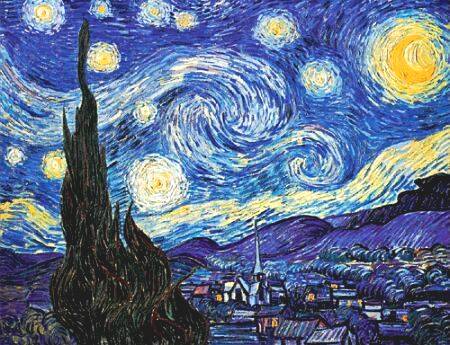
But I also get your meaning of forgiveness being deep-rooted within the landscape of eternity which meshes completely with a poem I once read on Van Gogh's "Starry Night" where it describes conscience as "the human height in the infinite whole".
Re: If God is so merciful, then why did Jesus have to be sacrificed?
This always has a special meaning for me, even with the comedy.Immanuel Can wrote:Harbal wrote:Not at all. But mere reason will not inform you of what God has done, if that action of His is not a mere product of routine procedures of Nature. A "miracle," by definition, is a suspension or contravention of physical regularities, made only possible by God's action. It's the sort of thing that only One who has created the Universe in the first place could do.You can't really be saying it is good for us to abandon our sense of reason, can you?
What reason WILL do for you is remind you that this just doesn't ordinarily happen. In fact, if it ever does, it would be a complete.....miracle.
https://www.youtube.com/watch?v=GwkgGPvClF4&t=45s
Re: If God is so merciful, then why did Jesus have to be sacrificed?
You always state categorically IT IS THE TRUTH without the slightest probability underpinning it and very rarely that you BELIEVE it is the truth. In doing so you renounce faith in favor of your own self-endorsed truth which has no relation to the real thing.Immanuel Can wrote:Actually, Belinda, I see nothing in that with which I can find reason to disagree. One's relationship with God is not an institutional matter. So I'd have to say "yes" to all that.Belinda wrote:The religion is irrelevant, ignore the messenger and look at the message, that is what is important. The religion could be the meanest, most despicable institution ever, and it wouldn't matter, what matters is your relationship with God. As long as the religious institution delivers the message correctly, that is all that matters.
Thedoc's right: it's the message that matters. Human beings are fallible, even at their very best. But if the message is the truth, then it's one's response to the message -- and, thereby, to God Himself -- that is everything.

Re: If God is so merciful, then why did Jesus have to be sacrificed?
I disagree. While it's hard not to be sympathetic to the idea of the Earth as a level of hell, any problems we perceive in our reality are ultimately trivial (noting that our deaths are trivial events). The Earth is far from moribund - it is an extraordinary and magnificent entity that is simply maturing and developing as it's always done. We are part of that development and, in evolutionary terms, humans became sentient enough to understand what roughly what they were doing about a minute ago. How can humanity be judged for failing to become immediately experienced and wise?Immanuel Can wrote:Sin has many consequences, but the worst of them is death. Or, to put it Biblically, "The wages of sin is death." But along with death comes all the associated miseries of living in an entropic, moribund world, cut off from the Ultimate Source of life. This manifests in "unhealth" of many forms: some physical, but much more emotional, spiritual, mental, social...and so on. Our world is badly messed up, in many dimensions; and so are we. What we need is healing from all these pathologies; and ultimately some way to escape their final consequence, death itself.
In this time of ever more rapid gratification, the slow and inexorable march of evolution towards greater sophistication and complexity seems intolerably slow for many idealists, who then spit their metaphorical dummies in disgust and deny that any development is happening at all and claim that everything is going to hell. They irrationally treat what happens over decades as indicative of the larger picture of reality. They use logic akin to judging a person's entire life and character by the dynamics occurring in a minutes or two of that life.
Oh ye of little faith!

People are fooled into thinking that the progression isn't happening because many parts of nature, including many human parts, are breaking down into simpler states - their energy stolen to power the progression amongst parts of humanity. The key term here is "parts of" - the idea of a shared fate for humanity was always only theoretical.
Many humans are being left behind, along with other species, to scratch out a living in the ever more barren areas surrounding "concentrations of progress". That is what nature does - it concentrates into temporarily self-sustaining controlling entities that operate in an ever more depleted environment due to the entity's increased energy needs. Intelligent life is basically doing to simpler entities what the Earth itself did in the protoplanetary cloud - it is clearing its space.
So humans are just another phase of the Earth's development; there is no more to forgive than there is to forgive the planet Earth for destroying or displacing countless asteroids, rocks and dust in its formation. Should the rest of the body forgive the brain for encephalisation - hogging resources and taking control?
It's rational to be concerned about the challenges facing us and our following generations. It's not rational to assume that the Earth is a form of hell. It's growing pains. It's the pain of change, of restructuring.
Last edited by Greta on Tue Apr 11, 2017 4:34 am, edited 2 times in total.
-
Immanuel Can
- Posts: 30246
- Joined: Wed Sep 25, 2013 4:42 pm
Re: If God is so merciful, then why did Jesus have to be sacrificed?
And if it is?Dubious wrote:You always state categorically IT IS THE TRUTH ...
After all, what's the point in believing a thing you DON'T genuinely believe to be the truth?
 That would be a very strange way to go through life.
Re: If God is so merciful, then why did Jesus have to be sacrificed?
The question I was wondering about earlier is whether there is any the significance for us in reality being "one big absolute thing". IC focused on prosaic misapplied examples of everyday "absolutes". It is a question I wonder about because that "one big absolute thing" seems more remote from us than any of its internal relative aspects, in which case I wonder what the fuss is about.Belinda wrote:Eternity has to either be or not be, so eternity isn't relatively this or that. Our point of view from this relative world is a different point of view from that of eternity. Like the rabbit/duck drawing which is also absolutely the duck or absolutely the rabbit at any one time, cannot be relatively duck.Greta wrote:Does eternity only exist in a relative sense or is it a theoretical construct based on our observations as small things within very much larger things?
BTW eternal isn't a synonym for everlasting.
Agreed. Some have described us as "the storytelling ape". We tell such a small percentage of all the stories out there. Consider the story of a carbon atom, formed in a supernova billions of years ago, travelling unimaginable distances to be part of the Earth, passing through countless organisms to find itself in an active neuron in Einstein's brain the moment he thought of E=MC², and the future ramifications of that event. Then again, that entire story could be also represented algebraically and mathematically.Belinda wrote: I think you are right that our observations of particular things are the bases of our constructs of very much larger things. I'd add to "larger things" also abstract things such as quantities, and also fantasies . In this sort of manner the more creative of us invent myths, poems, novels, i.e. narratives that express large abstract ideas (such as absolute forgiveness for instance). The less creative of us invent narratives which are relatively meaningless and at most have entertainment value e.g. pornography.
Yet, most "stories" - be they imaginative literary work or pure maths or geometry - do not have correlates in reality. There are many more possibilities than are manifest.
Re: If God is so merciful, then why did Jesus have to be sacrificed?
That is the point, It is not that particular atom but any carbon atom would do, just as it's not this particular planet, but any planet with the right conditions would do. It could have been any star that produced the elements that make up living things, and any planet that could have spawned intelligent life, it just happened to be this one. God set things in motion but didn't point a finger at this particular planet, God is patient and just waited for things to happen.Greta wrote: Consider the story of a carbon atom, formed in a supernova billions of years ago, travelling unimaginable distances to be part of the Earth, passing through countless organisms to find itself in an active neuron in Einstein's brain the moment he thought of E=MC², and the future ramifications of that event. Then again, that entire story could be also represented algebraically and mathematically.
Yet, most "stories" - be they imaginative literary work or pure maths or geometry - do not have correlates in reality. There are many more possibilities than are manifest.
Claiming that God is impatient, is anthropomorphizeing and stupid.
Re: If God is so merciful, then why did Jesus have to be sacrificed?
Dubious wrote:You always state categorically IT IS THE TRUTH ...
...the probability of that being less than minuscule to the point where even that fades in the light of facts. If you ask, what facts, as I know you would, will only prove that your entire thinking is based not merely on the ahistorical but more so on the anti-historical which, of course, creates a monumental credibility gap in any debate on the subject.Immanuel Can wrote:And if it is?
...which is another way of stating that what you believe to be the truth becomes the TRUTH! Belief becomes the criteria for truth...which makes sense since that is the modus operandi of all theism. There exists no other means to make its "truth" assertions.After all, what's the point in believing a thing you DON'T genuinely believe to be the truth?
Re: If God is so merciful, then why did Jesus have to be sacrificed?
Nobody is claiming that God is impatient. How in tarnation did you get that from my post? I would be interested to know.thedoc wrote:That is the point, It is not that particular atom but any carbon atom would do, just as it's not this particular planet, but any planet with the right conditions would do. It could have been any star that produced the elements that make up living things, and any planet that could have spawned intelligent life, it just happened to be this one. God set things in motion but didn't point a finger at this particular planet, God is patient and just waited for things to happen.Greta wrote: Consider the story of a carbon atom, formed in a supernova billions of years ago, travelling unimaginable distances to be part of the Earth, passing through countless organisms to find itself in an active neuron in Einstein's brain the moment he thought of E=MC², and the future ramifications of that event. Then again, that entire story could be also represented algebraically and mathematically.
Yet, most "stories" - be they imaginative literary work or pure maths or geometry - do not have correlates in reality. There are many more possibilities than are manifest.
Claiming that God is impatient, is anthropomorphizeing and stupid.
Re: If God is so merciful, then why did Jesus have to be sacrificed?
Not from your post, everything is not about you. And there are some who claim that God can't be patient, they are anthropomorphizeing because they are impatient.Greta wrote: Nobody is claiming that God is impatient. How in tarnation did you get that from my post? I would be interested to know.