And yet they can simulate computational neurons that cannot be deterministically analysed?Impenitent wrote:it's still binary
computers are nothing but glorified boxes of sequential on and off switches...
-Imp
Mathematics & Reality
-
Arising_uk

- Posts: 12255
- Joined: Wed Oct 17, 2007 2:31 am
Re: Mathematics & Reality
-
Impenitent
- Posts: 6159
- Joined: Wed Feb 10, 2010 2:04 pm
Re: Mathematics & Reality
how does one simulate that which cannot be analyzed?Arising_uk wrote:And yet they can simulate computational neurons that cannot be deterministically analysed?Impenitent wrote:it's still binary
computers are nothing but glorified boxes of sequential on and off switches...
-Imp
-Imp
-
Arising_uk
- Posts: 12255
- Joined: Wed Oct 17, 2007 2:31 am
Re: Mathematics & Reality
Sorry, probably not clear but if you run a suitably complex, i.e. a lot of layered nodes, simulated computational neuronal net to solve a problem then you can't tell how its going to solve it, i.e. what path or weights it will use, unlike a digital algorithm where you know the steps it'll have to take to solve the problem if there is a solution.Impenitent wrote:how does one simulate that which cannot be analyzed?
-Imp
-
Impenitent
- Posts: 6159
- Joined: Wed Feb 10, 2010 2:04 pm
Re: Mathematics & Reality
the possibility of making 3 left turns to go right as opposed to being programmed to turn right...Arising_uk wrote:Sorry, probably not clear but if you run a suitably complex, i.e. a lot of layered nodes, simulated computational neuronal net to solve a problem then you can't tell how its going to solve it, i.e. what path or weights it will use, unlike a digital algorithm where you know the steps it'll have to take to solve the problem if there is a solution.Impenitent wrote:how does one simulate that which cannot be analyzed?
-Imp
how does one program freedom?
-Imp
-
Arising_uk
- Posts: 12255
- Joined: Wed Oct 17, 2007 2:31 am
Re: Mathematics & Reality
Thats choice for you.Impenitent wrote: the possibility of making 3 left turns to go right as opposed to being programmed to turn right...
Who said we are free?how does one program freedom?
Re: Mathematics & Reality
God I think.Arising_uk wrote:Thats choice for you.Impenitent wrote: the possibility of making 3 left turns to go right as opposed to being programmed to turn right...Who said we are free?how does one program freedom?

Everyone else seems to have some very illuminating contentions to this absolutist fact.
If you believe in integral calculus and the reality it much more effectively approximates but Zeno could not of know about, he was wrong though.Impenitent wrote:if you believe in division, Zeno was correct...
but things move don't they?
-Imp
Which would you rather believe in reality mathematical or not or a flawed philosophical contention?
Take a material like uranium give it a half life and in the end you are left with nothing given several billion years. That is how reality operates, and the way that operates is no different than zenos world contained, but it completely has to be taken into account, or you are just pissing in the wind.
1/2 something is not always equal to 1/2 something else over time. Reality has shown us this is every instant, why should we deny it for the sake of a fiction that does and never could reflect the real world?
People who use Zeno's contentions as an actual paradox are quite frankly naïve at best and deluded at worst.
A ball bounces, but I am sure everyone agrees eventually it stops moving, the reasons are obvious to anyone with a half baked idea about reality let alone an educated one.
Re: Mathematics & Reality
What do either of you mean, Impediment or Blaggard?
What is belief in division?
What is belief in integral calculus?
To what degree is belief in mathematical operations an act of faith?
What is belief in division?
What is belief in integral calculus?
To what degree is belief in mathematical operations an act of faith?
We all have at least a half baked understanding of why balls don't bounce in perpetuity, but that is not because the reasons are obvious. They are now, to anyone with any appreciation of the last two and a half thousand years of philosophy and science. Hume argued that causality is only learnt by experience, which is why for anything to pass as science, it must predict some effect that is demonstrated with sufficient predictability for people (who aren't cranks) to stop arguing about it.Blaggard wrote:A ball bounces, but I am sure everyone agrees eventually it stops moving, the reasons are obvious to anyone with a half baked idea about reality let alone an educated one.
Re: Mathematics & Reality
Integral calculus bases its believability on it's ability to model reality. End of the day reality is modeled with in a margin of error as it always is. We could of course just say our models are just wrong, or we could say the approximation +/- (maths and science has a name for this, and 5 degrees of margin of error is usually considered sufficient for a positive result) a margin of error is good enough, assuming it is agreed to by more objective means and further testing.
If you go far enough you can prove nothing is real, and nothing is x, but what is the point? Calculus models a system that is real, it is not in and of itself real, no maths is per se, although I am sure many would contend with that, but that is by the by.
Aristotle caluclated the volume of a sphere by noting that if you divided it up into enough slices as you approached infinite slices the value would become more accurate, infinite slices being precisely the value of the volume of a sphere, of course the volume of a sphere cannot be know precisely because pi is transcendental, it has an infinite number of decimals AFAIK, likewise any integral is too because you can't make infinite slices but... this is how he solved Zeno's paradox. Of course he didn't formalise calculus that took a further 1700 or so years, but what he did do was show that the turtle is going to be hit by the arrow, or what not.
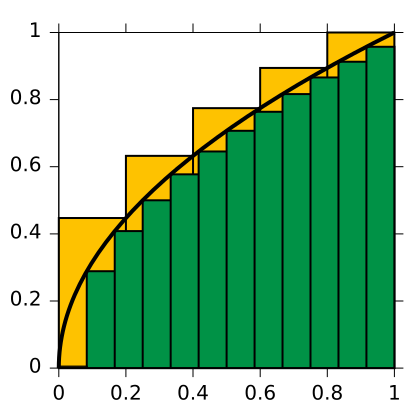
You see there, the gaps under the line show that that number of slices is not quite right you can see the area under the line has yellow parts so the green total of area is obviously wrong, but what if you had more slices, what then if you had infinite slices? Clearly as you introduce more slices the yellow area begins to become vanishingly small until at infinity it disappears entirely. Welcome to the fundamental rule of calculus, integrals in this case.
I am not sure if you mean to get into the difference between mats and reality, but hey knowck yourself out, it's probably a waste of time, as we all know all models are approximations.
We know 1 thing the ball stops bouncing, likewise in exactly, and I mean exactly the same way the arrow finds its mark, likewise the uranium atoms decay to nothing in precisely the same way, we can model why, it exhausts what we can know about the system. We take it as close enough because to do otherwise would be pointless.
Reality is the master, it's model the servant. But the model does solve the issue, because we know 1/2 of a 1/2 and then... infinitely leads to 0 at the limit of infinity, although it is wise to point out though the relation between time and motion is not precisely y = x at t, interestingly phsyical laws prevent things like this, entropy, energy concerns etc, it is not reality but it is good enough.
In calculus gibberish you would say dx/dy is related to dx/dt, or the motion of x and hence y is related to x and t(time), the / does not mean division necessarily although it can do, it means there are dependent and independent variables. Motion is dependent on time, time is seemingly constant if all things are equal. Ok that's a differential the rate of change in the line of the graph, but since an integral undoes what a differential does the relationship is dependent.
The integral of pi r^2 = 1/3 pi r^3+c (c being a constant, although we can probably ignore that as pi already is) the differential of that is equal to pi r^2.
I could wax on about if you use the golden constant and a volumetric integral you will end up with 4/3 pir r^3, the volume of a sphere, but I think you are bored enough, and that assumes you even made it this far, I know I probably wouldn't if I didn't study maths, f*** that.
If you go far enough you can prove nothing is real, and nothing is x, but what is the point? Calculus models a system that is real, it is not in and of itself real, no maths is per se, although I am sure many would contend with that, but that is by the by.
Aristotle caluclated the volume of a sphere by noting that if you divided it up into enough slices as you approached infinite slices the value would become more accurate, infinite slices being precisely the value of the volume of a sphere, of course the volume of a sphere cannot be know precisely because pi is transcendental, it has an infinite number of decimals AFAIK, likewise any integral is too because you can't make infinite slices but... this is how he solved Zeno's paradox. Of course he didn't formalise calculus that took a further 1700 or so years, but what he did do was show that the turtle is going to be hit by the arrow, or what not.
You see there, the gaps under the line show that that number of slices is not quite right you can see the area under the line has yellow parts so the green total of area is obviously wrong, but what if you had more slices, what then if you had infinite slices? Clearly as you introduce more slices the yellow area begins to become vanishingly small until at infinity it disappears entirely. Welcome to the fundamental rule of calculus, integrals in this case.
I am not sure if you mean to get into the difference between mats and reality, but hey knowck yourself out, it's probably a waste of time, as we all know all models are approximations.
We know 1 thing the ball stops bouncing, likewise in exactly, and I mean exactly the same way the arrow finds its mark, likewise the uranium atoms decay to nothing in precisely the same way, we can model why, it exhausts what we can know about the system. We take it as close enough because to do otherwise would be pointless.
Reality is the master, it's model the servant. But the model does solve the issue, because we know 1/2 of a 1/2 and then... infinitely leads to 0 at the limit of infinity, although it is wise to point out though the relation between time and motion is not precisely y = x at t, interestingly phsyical laws prevent things like this, entropy, energy concerns etc, it is not reality but it is good enough.
In calculus gibberish you would say dx/dy is related to dx/dt, or the motion of x and hence y is related to x and t(time), the / does not mean division necessarily although it can do, it means there are dependent and independent variables. Motion is dependent on time, time is seemingly constant if all things are equal. Ok that's a differential the rate of change in the line of the graph, but since an integral undoes what a differential does the relationship is dependent.
The integral of pi r^2 = 1/3 pi r^3+c (c being a constant, although we can probably ignore that as pi already is) the differential of that is equal to pi r^2.
I could wax on about if you use the golden constant and a volumetric integral you will end up with 4/3 pir r^3, the volume of a sphere, but I think you are bored enough, and that assumes you even made it this far, I know I probably wouldn't if I didn't study maths, f*** that.
Re: Mathematics & Reality
One of the corner stones of philosophy is that you cannot prove nothing is real. It is self refuting to argue that there is nothing. Whether anything we experience corresponds to any reality is a different question.Blaggard wrote:If you go far enough you can prove nothing is real,.
Well, no. The fact that you cannot make infinite slices is Zeno's paradox. It's not a big deal now, but at the time the Pythagoreans were trying to turn maths into religion, believing it could explain everything. As you say, within a margin of error, it can, but like all understanding, it isn't perfect.Blaggard wrote:Aristotle caluclated the volume of a sphere by noting that if you divided it up into enough slices as you approached infinite slices the value would become more accurate, infinite slices being precisely the value of the volume of a sphere, of course the volume of a sphere cannot be know precisely because pi is transcendental, it has an infinite number of decimals AFAIK, likewise any integral is too because you can't make infinite slices but... this is how he solved Zeno's paradox.
Re: Mathematics & Reality
It's a brilliant argument given what Zeno knew I quite agree.
And the fact that you can approximate is Zenos failing (although that seems a little harsh given what he knew), there is no use in arguing that reality is wrong because of semantics, if you can get close enough to reality as so it make sno appreciable difference when modelled, it is to all intents and purpose good enough. We know isotopes decay by such a precise margin that we can tell you to the microsecond when there will be none of it left. In the same way we can tell you that a ball stops bouncing and that an arrow hits its mark. This dumb idea that everything has to be perfect is all it is, a dumb idea. Nothing is perfect, expecting it to be so is pointless. You can of course whang on about how everything should be modelled perfectly because it just well should, and I want it to be. Reality isn't like that though, people need to get over it.
Would you argue that a model that put a man on the moon is wrong, when a man landed on the moon, exactly where they wanted him to? Would you argue that a model that created all modern technology is wrong just because it is not 100% accurate but an approximation. Would you argue that a ball cannot stop bouncing. Why, seems like an exercise in denying reality?
Arguing about these tiny and insignificant differences is pointless to my mind. Reality is what it is, if you can approximate it to such a degree that a million experiments run a billion times would produce the exact same result to a margin of error that is so small that had you run it a quadrillion times the results would all of been, almost, over a billion years it took you to run them, the same. Why would you claim Aristotle was wrong? When in fact we know he solved the problem, and he did it well. It just wasn't perfect, booo fricking who, who cares, nothing is.
Zenos paradox is wanking material for people who want the universe to be perfect when it clearly can't be. It's no more a paradox than Einstien's twin paradox was. But it is good wanking material on the top shelf, you'd perhaps steer clear of some ideas, but that one would have all you need to get you off, and your eye would linger on it.
pi doesn't end and neither does peoples insistence that things that don't end mean things are somehow inherently wrong because of approximation. It's dumbery quite frankly. A waste of time and effort.
We can never define the area of a circle perfectly, it is impossible, even if we were to go to a scale so small ie beyond numbers we could count in our life time or the lifetime of the universe, we couldn't. 2 facts present themselves, see if you can guess what they are. See if you can guess how much anyone would give a shit therefore.
Nothing is real (probably explained it badly I meant in maths, it is kind of pointless proving it is real is what I meant), it is undefined too in some cases, we tend to just see it as a marker hence it's real though, I don't think anyone really cares. In context though it was a mathematical prescription based on axioms, not a suggestion that you can prove nothing physically is real, so I fail to see the point of belabouring it I am afraid but by all means digress anyway, sincerely it's a very interesting area of philosophy to me and I certainly would welcome something of that ilk, not on this thread but meh.
"Euclid alone has looked on beauty bare."
Edna St Vincent Millay.
Maths is a whore I would say, but then that is why I am not a poet...
I should probably mention although Aristotle came up with the philosophical solution, which was indeed correct, without exhaustive mathematics, it was Democratus and Archimedes who put the baby to bed.
And the fact that you can approximate is Zenos failing (although that seems a little harsh given what he knew), there is no use in arguing that reality is wrong because of semantics, if you can get close enough to reality as so it make sno appreciable difference when modelled, it is to all intents and purpose good enough. We know isotopes decay by such a precise margin that we can tell you to the microsecond when there will be none of it left. In the same way we can tell you that a ball stops bouncing and that an arrow hits its mark. This dumb idea that everything has to be perfect is all it is, a dumb idea. Nothing is perfect, expecting it to be so is pointless. You can of course whang on about how everything should be modelled perfectly because it just well should, and I want it to be. Reality isn't like that though, people need to get over it.
Would you argue that a model that put a man on the moon is wrong, when a man landed on the moon, exactly where they wanted him to? Would you argue that a model that created all modern technology is wrong just because it is not 100% accurate but an approximation. Would you argue that a ball cannot stop bouncing. Why, seems like an exercise in denying reality?
Arguing about these tiny and insignificant differences is pointless to my mind. Reality is what it is, if you can approximate it to such a degree that a million experiments run a billion times would produce the exact same result to a margin of error that is so small that had you run it a quadrillion times the results would all of been, almost, over a billion years it took you to run them, the same. Why would you claim Aristotle was wrong? When in fact we know he solved the problem, and he did it well. It just wasn't perfect, booo fricking who, who cares, nothing is.
Zenos paradox is wanking material for people who want the universe to be perfect when it clearly can't be. It's no more a paradox than Einstien's twin paradox was. But it is good wanking material on the top shelf, you'd perhaps steer clear of some ideas, but that one would have all you need to get you off, and your eye would linger on it.
pi doesn't end and neither does peoples insistence that things that don't end mean things are somehow inherently wrong because of approximation. It's dumbery quite frankly. A waste of time and effort.
We can never define the area of a circle perfectly, it is impossible, even if we were to go to a scale so small ie beyond numbers we could count in our life time or the lifetime of the universe, we couldn't. 2 facts present themselves, see if you can guess what they are. See if you can guess how much anyone would give a shit therefore.
Yeah I've said that before myself in dozens of posts, no one cares not even me and I said it.uwot wrote:One of the corner stones of philosophy is that you cannot prove nothing is real. It is self refuting to argue that there is nothing. Whether anything we experience corresponds to any reality is a different question.Blaggard wrote:If you go far enough you can prove nothing is real,.
Nothing is real (probably explained it badly I meant in maths, it is kind of pointless proving it is real is what I meant), it is undefined too in some cases, we tend to just see it as a marker hence it's real though, I don't think anyone really cares. In context though it was a mathematical prescription based on axioms, not a suggestion that you can prove nothing physically is real, so I fail to see the point of belabouring it I am afraid but by all means digress anyway, sincerely it's a very interesting area of philosophy to me and I certainly would welcome something of that ilk, not on this thread but meh.
http://mathforum.org/library/drmath/view/56029.htmlMy first question is, "Is 0 a real number?"
I will, based upon your answers, be asking you more questions.
Date: 09/26/2001 at 23:42:09
From: Doctor Peterson
Subject: Re: "0" and "-0"
Hi, Patrick.
Yes, since zero is an integer, and all integers are real numbers, zero
is a real number.
- Doctor Peterson, The Math Forum
http://mathforum.org/dr.math/
Date: 09/27/2001 at 15:09:40
From: (anonymous)
Subject: "0"
My friend Sean and I think we have disproved that 0 is a real number.
0 doesn't follow several of the properties, such as the inverse
property of multiplication, and several division properties. In the
definition of opposites, "Any 2 points on a number line that are
equidistant from the origin (0)." Also, "any real number multiplied
by -1 will give you the opposite of that number." So, in essence,
0 * -1 =0. However, 0 could not possibly be the opposite of 0
according to the definition of opposites, because, even though 0 is
equidistant from zero in coordinates to 0, they are not two separate
points, thus proving that 0 doesn't follow all real number properties.
Date: 09/27/2001 at 22:17:40
From: Doctor Peterson
Subject: Re: "0"
Hi, Patrick and Sean.
You have to be very careful when you talk about definitions. The
concept of real number starts with integers, which include zero, as I
said, so their properties are determined based on a definition that
includes zero as a real number! To then use those properties to prove
that zero is not one of the numbers they refer to suggests that you
have misunderstood them. And in fact, it is all too common to state
such properties too broadly, without giving all the conditions.
First, nobody says that all real numbers have an inverse; rather, we
say that all real numbers EXCEPT ZERO have an inverse. Yes, that means
that zero is unique among the real numbers; but it doesn't mean it is
not one of them. Zero is in fact the starting point of the whole
system (you use it as part of your definition of "opposite"), and it's
really not too surprising that the foundation should have some unique
properties.
Second, when we say that every real number has an opposite, that does
not mean that the opposite has to be a DIFFERENT real number.
Mathematicians use words very carefully, and when we mean "different"
or "distinct" or "unique" we say so explicitly. Zero is its own
opposite; there is no other number the same distance (zero) from the
origin.
Your definition of "opposite" is a poor one, and not one on which we
would base any careful reasoning. It's really just a description, to
help you visualize the concept. Since it sounds as if you enjoy deeper
mathematical thinking, why don't you look in a good library for a
solid text on algebra or number theory, one that you can follow but
that you find challenging, and start going through it. Once you get a
feel for how really solid definitions and theorems are made, you'll be
able to take off on your own and start really discovering good ideas.
- Doctor Peterson, The Math Forum
"Euclid alone has looked on beauty bare."
Edna St Vincent Millay.
Maths is a whore I would say, but then that is why I am not a poet...
I should probably mention although Aristotle came up with the philosophical solution, which was indeed correct, without exhaustive mathematics, it was Democratus and Archimedes who put the baby to bed.
Re: Mathematics & Reality
Well, there's two parts to it: That you cannot divide space or time up indefinitely. That may or may not be true, but for practical reasons we can never know, as Max Planck pointed out. Secondly, arrows quite clearly do reach the target, but as far as Zeno was concerned, the phenomenal world is not reality.Blaggard wrote:It's a brilliant argument given what Zeno knew I quite agree.
And the fact that you can approximate is Zenos failing (although that seems a little harsh given what he knew), there is no use in arguing that reality is wrong because of semantics,
Absolutely.Blaggard wrote:if you can get close enough to reality as so it make sno appreciable difference when modelled, it is to all intents and purpose good enough.
Zeno was trying to support Parmenides contention that there is a world of immutable, perfect 'reality' that underpins the world of phenomena that we inhabit. It is a dumb idea, but that didn't stop Plato adapting it into his theory of forms. Aristotle's take on it was that beyond the terrestrial elements, earth, water, air and fire, in other words, in heaven, everything is made of aether; a perfect substance that moves in perfect circles. Medieval scholars incorporated those ideas into the Christian idea of heaven, even Copernicus thought the heavenly bodies moved in perfect circles.Blaggard wrote:We know isotopes decay by such a precise margin that we can tell you to the microsecond when there will be none of it left. In the same way we can tell you that a ball stops bouncing and that an arrow hits its mark. This dumb idea that everything has to be perfect is all it is, a dumb idea.
Blaggard wrote:Nothing is perfect, expecting it to be so is pointless.
Indeed, but the idea of a 'perfect human being', Jesus or Mohammed, for instance, that we should strive to emulate, are deeply entrenched and, as history keeps showing, dangerous when left in the hands of nutters.
I think people need it explained to them.Blaggard wrote:You can of course whang on about how everything should be modelled perfectly because it just well should, and I want it to be. Reality isn't like that though, people need to get over it.
To each their own. Zeno, I think, is an object lesson on why you should trust your senses rather than your mind.Blaggard wrote:Zenos paradox is wanking material for people who want the universe to be perfect when it clearly can't be.
Re: Mathematics & Reality
Trust the consensus of senses, since yours are just an extended part of your mind, a sort of a gestalt of mind that does not only reside in the brain but is processed by it. But yeah I agree with all of the above.
Re: Mathematics & Reality
Missed this earlier. We only know about Zeno's paradoxes, because of Aristotle's analyses, although Plato alluded to them in the Parmenides. Aristotle's solution, at least to one of them, is that change is possible because as the spatial change you are measuring becomes smaller, so does time. Which, at least as I understand it, is one principle behind calculus. It is a pragmatic, rather than epistemological solution.Blaggard wrote:I should probably mention although Aristotle came up with the philosophical solution, which was indeed correct, without exhaustive mathematics, it was Democratus and Archimedes who put the baby to bed.
Democritus too was responding to Parmenides and was partially in agreement with him. Parmenides had argued that reality was effectively solid, thus nothing could move. Just to reiterate, reality and the phenomenal world, ie, everything we experience, are two different things. Democritus agreed that 'real' things cannot be divided indefinitely, but, quite reasonably argued that the phenomenal world is the 'real' one. Fundamental constituents of matter must likewise be uncuttable, atomos in Greek. This results in the miniature billiard ball atoms we know perfectly well they are not. Physicists who are prepared to make ontological claims about fundamental particles, at least publicly, are rare. Our current understanding of fundamental particles is a combination of sorts. According to some physicists, there is a quantum field that is essentially infinite, much as Parmenides argued. Unlike Parmenides' 'being' though, the quantum field is not flawless, rather it is something that can be in excited states. In essence, fundamental particles are what David Deutsch calls "excitations of the vacuum", energy is basically the movement of the excitations. It happens that at certain levels of excitation, particular particles cause effects that we can register, notably the emission or absorption of photons by atoms. The vast bulk of excitations are not of the requisite frequency to achieve this and have no or little demonstrable effect. They are nonetheless energetic and therefore contribute to dark matter and may even be all of it. This explains it better than I can:
http://www.physics.adelaide.edu.au/theo ... leinweber/
I don't know what Archimedes contributed to it all. He came up with a counting system that was a forerunner to exponentiation, which is a great help when talking about the numbers involved, but I'm not a historian of maths.
Re: Mathematics & Reality
Interesting stuff thanks. Wiki is not that good a source, the wiki citations are better though so meh, nice to see it laid out.
Mentioned Archimedes on the wiki in passing, this is a discussion I had before, so I might of got some things wrong, feel free to check the wiki for details, hell correct them as well, it's the only way they'll learn.
I think excitations reveals very little about the contentions atm, what we are is lost on a sea of energy. It's much like where we were on gravity 500 years ago, and where we are now, I'd say we know a lot, but not enough. What may come who knows? That's what science is for of course.
http://en.wikipedia.org/wiki/Taylor_series
Mentioned Archimedes on the wiki in passing, this is a discussion I had before, so I might of got some things wrong, feel free to check the wiki for details, hell correct them as well, it's the only way they'll learn.
I think excitations reveals very little about the contentions atm, what we are is lost on a sea of energy. It's much like where we were on gravity 500 years ago, and where we are now, I'd say we know a lot, but not enough. What may come who knows? That's what science is for of course.
For completeness from the wiki:The Greek philosopher Zeno considered the problem of summing an infinite series to achieve a finite result, but rejected it as an impossibility: the result was Zeno's paradox. Later, Aristotle proposed a philosophical resolution of the paradox, but the mathematical content was apparently unresolved until taken up by Democritus and then Archimedes. It was through Archimedes's method of exhaustion that an infinite number of progressive subdivisions could be performed to achieve a finite result.[1] Liu Hui independently employed a similar method a few centuries later.[2]
In the 14th century, the earliest examples of the use of Taylor series and closely related methods were given by Madhava of Sangamagrama.[3][4] Though no record of his work survives, writings of later Indian mathematicians suggest that he found a number of special cases of the Taylor series, including those for the trigonometric functions of sine, cosine, tangent, and arctangent. The Kerala school of astronomy and mathematics further expanded his works with various series expansions and rational approximations until the 16th century.
In the 17th century, James Gregory also worked in this area and published several Maclaurin series. It was not until 1715 however that a general method for constructing these series for all functions for which they exist was finally provided by Brook Taylor,[5] after whom the series are now named.
The Maclaurin series was named after Colin Maclaurin, a professor in Edinburgh, who published the special case of the Taylor result in the 18th century.
http://en.wikipedia.org/wiki/Taylor_series