lennartack wrote:Arising_uk: you can actually make that experiment compatible with this consciousness stuff. The wave function will seem to have been collapsed in the past when you observe the date, but it could as well have collapsed at the moment you observed your data, thereby "changing" the past.
What actual experiment, as opposed to thought experiment, can this been done with?
Arising_uk wrote:Too slippery for me but I just about understand how the physicists now say about what can be included in the calculation of quanta. What always baffles me is that everyone gets off on the idea of this 'wave' but it looks to be all particles and the calculation of where it probably is.
You old corpuscularian you.
Arising_uk wrote:Now what I think all budding philosophers of science should be interested and boggled by is the idea that Physics has abandoned truth for probably true and the world hasn't collapsed nor has Maths.
Nor did it when physicists twigged the problem of induction.
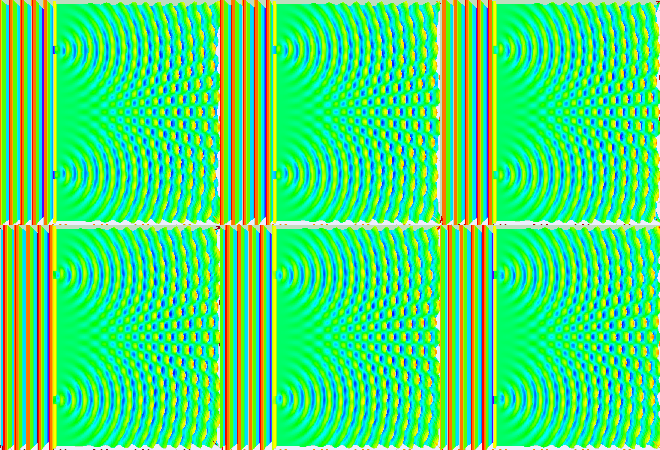
Ginkgo wrote:The wave analogy is used because it best fits the experimental results. The electron goes through both slits at the same time and interferes with itself, thus creating a wave pattern on the detector.
The way the experiment is described is typically that 'even when the photons are fired on at a time, the detector builds up an interference pattern'. This gives the impression that photons are in fact particles, solid little balls, that don't know how to behave properly. Quite clearly, they are not. It's yer hypotheses non fingo, innit? For all that you can treat them like that mathematically, physicists are very reluctant to make any statement about what they think is physically happening. But, as noted in another thread, Robert Laughlin says: "The modern concept of the vacuum of space, confirmed every day by experiment, is a relativistic ether. But we do not call it this because it is taboo"; 'particles' are neatly described as waves, perturbations, knots, twists, call them what you will, in that medium, but to say such an 'aether' exists is metaphysics, because it wouldn't make any difference to the observed data.
Ginkgo wrote:I think the problem is this. It has been long claimed that the conscious mind is not really a problem for science. It is explained adequately by a physicalist explanation. Quantum mechanics is forcing a rethink of this and the role of consciousness in explaining 'reality'. In other words, consciousness is starting to become a fly in the ointment of traditional science.
Seriously; physicists are no better at philosophy than philosophers.